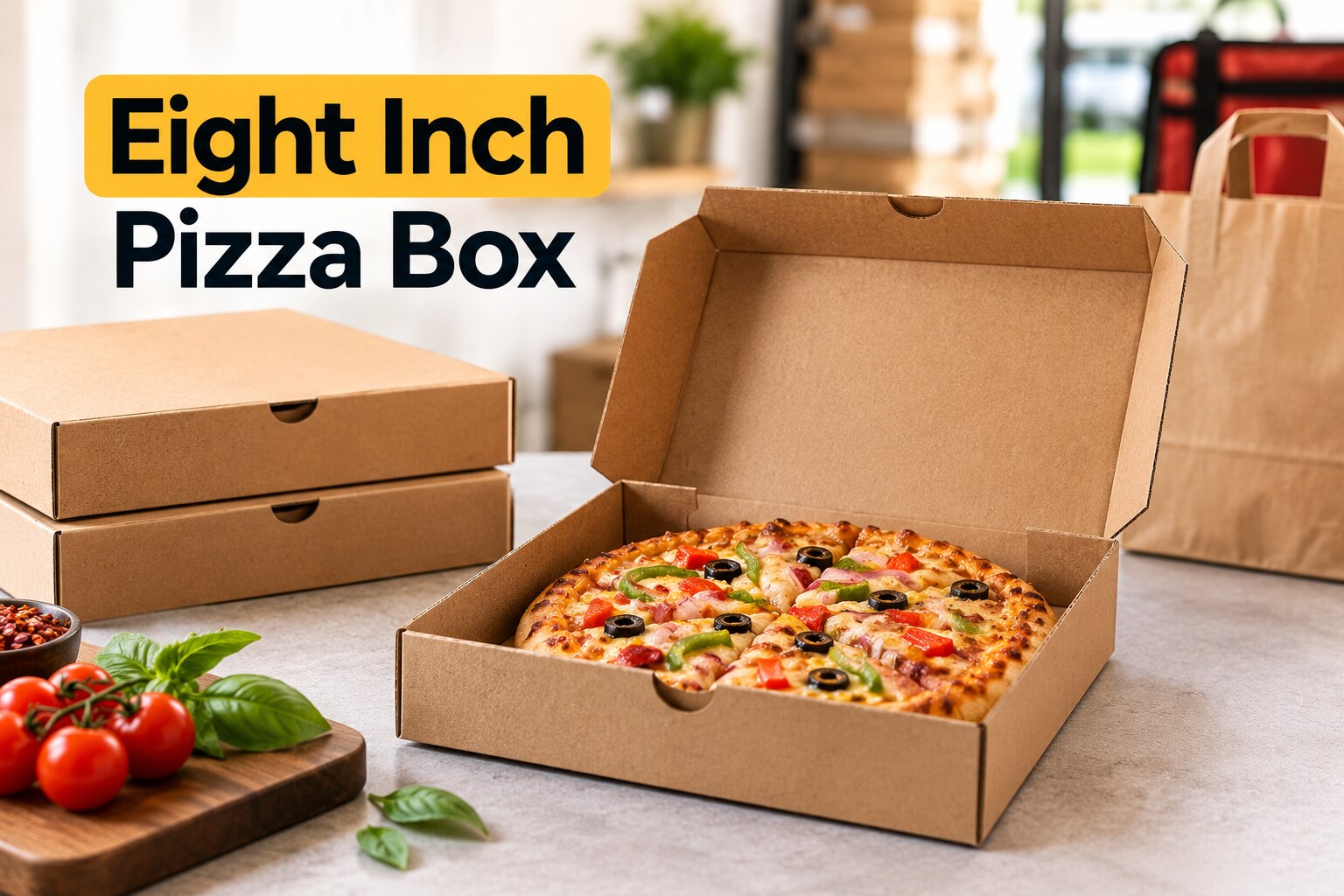
An eight-inch label does not tell you whether the carton will fit the pizza, survive a motorcycle route, or keep the crust firm. By checking the internal footprint, box construction, ventilation, stacking limits and delivered cost, you can decide when small pizza packaging improves takeaway operations and when a larger carton is safer.
Key takeaways
- Confirm 8.25 inches means usable internal width, not external size.
- A 1.5-inch box suits flat pizzas without tall toppings or excess crust.
- Test heat, grease, stacking and delivery damage before changing packaging.
- Compare total cost per delivered pizza, including assembly, storage and rejects.
Does an 8.25-inch box actually fit an eight-inch pizza?
Yes—an 8.25-inch box can fit an eight-inch pizza, but only when 8.25 inches is the usable internal width and the pizza measures eight inches at its widest point. That leaves 0.25 inch of total clearance, or about ⅛ inch on each side when centred.
It is workable for a regular round crust, but too little for a swollen edge or uneven hand-stretched base.
Confirm the fit with a physical sample rather than the carton label:
- Measure the pizza across its widest crust edge after baking, including any cheese or topping that reaches the side.
- Place it on the actual liner, centre it in the assembled box, and close the lid without pressing the topping.
- Tilt the closed box through the angles it will face in a delivery bag. If the pizza touches the walls or shifts enough to expose the crust, reject the size.
- Repeat the test with the largest pizza produced during a busy service, not only a neatly shaped sample.
A snug fit supports the 8 inch pizza box advantages: cleaner presentation, easier portion control and more efficient small pizza packaging. Excess space creates sliding during two-wheeler delivery, while insufficient space damages the crust or lid.
If your menu includes irregular crusts, heavy toppings or a pizza cutter’s handling tolerance, compare the 8.25-inch internal footprint with the next internal size before ordering.
What can a 1.5-inch pizza box height accommodate?
A 1.5-inch internal height accommodates a standard thin-crust pizza with a modest raised edge, ordinary cheese and toppings, and a flat paper liner. It becomes risky when extra cheese, tall vegetables, stuffed crust, deep-pan dough, or a rigid liner brings food close to the lid; contact smears toppings and traps steam.
| Combination | Fit within 1.5-inch internal height | Decision |
|---|---|---|
| Thin crust, normal toppings, paper liner | Usually fits with lid clearance | Suitable |
| Thin crust, raised edge, extra cheese, paper liner | Fits only if the edge and cheese stay below the lid | Test a packed sample |
| Thin crust, heavy toppings, absorbent liner | Height may fit, but toppings can touch the lid | Use a taller carton |
| Deep-pan or stuffed crust, rigid liner | Usually leaves insufficient clearance | Choose a deeper box |
Before ordering a pizza box for takeaway delivery, verify these construction details:
- Ask for the internal base length, width and usable height, not the advertised external size. Measure height after folding, because flap geometry can reduce lid clearance.
- Confirm whether the liner sits inside the stated height. A raised paperboard liner can remove several millimetres of working space.
- Check the board grade, flute direction and stacking strength. Corrugated pizza box benefits include better crush resistance and a stiffer lid, but they do not compensate for an undersized interior.
- Request a sample with vents, locking tabs and the intended liner. Close it over a freshly baked pizza for ten minutes; reject it if the lid touches toppings or condensation pools above the crust.
Will a small corrugated box protect pizza during takeaway delivery?
Yes, a small corrugated box can protect pizza during short or delayed delivery, but size alone does not make it strong. Fluting resists bending and panel collapse better than thin folding paperboard, while the small footprint improves stability. It is not an insulated container, so use a thermal delivery bag for temperature control.
Specify these performance points separately:
- Board grade and edge-crush strength for the actual stack, route and stacking duration; wet or under-strength board can deform even in a compact carton.
- Grease resistance that limits oil strike-through into the bag; a stiff box can still leak through its liner.
- Controlled vents or leakage paths that release steam without cooling the pizza rapidly or allowing grease to escape.
- A locking tab or secure closure that stays shut over road vibration but opens cleanly at handover.
A pizza box for takeaway delivery also needs limited internal movement. A little clearance prevents toppings touching the lid and speeds packing; too much lets the pizza slide during motorcycle transport. Test the closed box beneath the intended load, including stacked cartons, because a crushed lower box can press the lid onto the cheese.
The corrugated pizza box benefits disappear when the menu includes deep-pan crusts, irregular edges or heavily loaded toppings. For those products, choose a taller or wider carton rather than forcing one small format across every order.
Which eight-inch pizza box benefits matter to takeaway restaurants in Bangalore?
The biggest eight inch pizza box benefits for takeaway restaurants in Bangalore appear when one carton carries one standard eight-inch pizza with little wasted space. An 8-by-8-inch base uses 64 square inches, compared with 144 square inches for a 12-by-12-inch box—about 56% less footprint and, at equal height, about 56% less volume.
That frees shelf space, speeds packing and reduces pressure on hot-bag capacity.
Right-sizing also limits movement over speed breakers and two-wheeler turns. It improves order recognition when every carton contains an individual pizza. Do not make the fit tight: a small clearance helps the lid avoid toppings and gives staff room to pack without catching the crust.
| Option | Operational gain | When the gain disappears |
|---|---|---|
| 8-inch pizza only | Less storage, faster packing and better bag capacity | A raised edge, heavy toppings or a liner needs more internal room |
| Mixed individual pizzas | Fewer carton decisions at the packing bench | Different diameters, deep-pan bases or irregular crusts require separate packaging |
| Pizza plus sides or dips | One larger order carton may simplify handover | Cups, sauces and sides force empty space or crush the pizza |
These 8 inch pizza box advantages weaken on long, congested routes where ventilation, crush resistance and stable stacking matter more than compactness. Rain-soaked handover points and overloaded delivery bags also punish a carton that saves space but cannot protect the product.
Compare delivered cost per saleable pizza, including packing minutes, liners, rejected orders and bag capacity—not box price alone. Ankita Enterprises can help you compare internal dimensions and carton choices against your actual menu rather than selecting one small carton for every order.
Related product
 | Corrugated Box excellent quality of pizza box 8.25"/8.25"/1.5" size View product → |
How should you test, assemble and cost the box before switching?
Compare cartons on delivered cost per saleable pizza, not the invoice price. Run matched orders using the same eight-inch pizza, liner, toppings, route and hot bag. Record the time from oven to handover, temperature, lid contact, movement, grease leakage, condensation, crushed edges and customer-rejectable damage.
- Assemble each pizza box exactly as staff will: fold every locking tab, fit the liner or separator, and check whether the lid catches on toppings.
- Place the maximum planned stack in the hot bag, then repeat on a two-wheeler route with stops, turns and delays. Inspect the bottom box for compression and the top boxes for trapped steam.
- Time packing for each carton. Count boxes that need re-folding, replacement or extra tape.
- Add the box, liner, separator, storage cost, packing labour, damaged or rejected orders, and any delivery-bag capacity lost to each pizza.
- Request the board grade, flute profile, edge-crush specification, moisture details and a documented material and compliance declaration. “Food grade” alone does not demonstrate compliance with applicable Food Safety and Standards Authority of India food-contact requirements.
| Measure | Right-sized carton | Oversized carton |
|---|---|---|
| Box and insert | Lower material use; include every insert | Higher purchase and insert cost |
| Packing and storage | Faster handling; fewer shelves used | More folding space and storage |
| Delivery performance | Less movement if clearance is controlled | More sliding and bag capacity consumed |
| Saleable output | Cost rises with crushed or rejected pizzas | Cost rises with damage, movement or wasted capacity |
Choose the small pizza packaging that produces the lower total after testing, not the cheapest pizza box for takeaway delivery. Divide total operating cost by pizzas handed over in saleable condition.
Frequently asked questions
Does an 8.25-inch box actually fit an eight-inch pizza?
Yes, if 8.25 inches is the usable internal width and the pizza measures eight inches at its widest point. The centred pizza has about ⅛ inch of clearance on each side.
What can a 1.5-inch pizza box height accommodate?
A 1.5-inch box suits a flat pizza with standard toppings. Check the pizza’s highest point, including toppings and crust, before closing the lid.
Will a small corrugated box protect pizza during takeaway delivery?
A small corrugated box can protect the pizza from crushing and handling when its internal dimensions fit closely and the box is stacked correctly. Test it against heat, grease and delivery movement.
Which eight-inch pizza box benefits matter to takeaway restaurants in Bangalore?
Useful benefits include compact storage, lower material use, easier handling and a close fit that limits movement. Restaurants should also assess ventilation, stacking and performance during local delivery routes.
How should you test, assemble and cost the box before switching?
Measure the pizza at its widest and highest points, assemble sample boxes, test closed-box fit, and run delivery trials. Include box price, assembly time, storage space, damaged orders and rejected boxes in the cost comparison.
Keywords