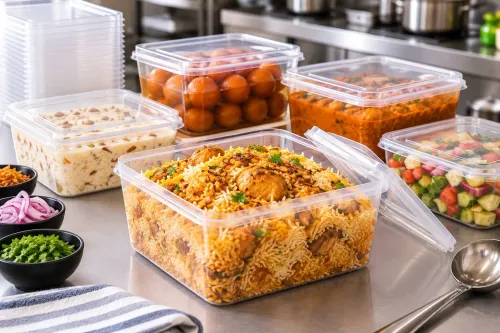
A 2000ml label tells you the container’s nominal volume, not how much biryani, curry or gravy you can safely send in it. To pack large portions reliably, you need to match usable capacity, food type, material, lid performance, filling method and delivery conditions.
Key takeaways
- Fill 1,600–1,800ml, leaving 10–20% headspace.
- Use square containers for layered meals, rice and stackable bulk orders.
- Check food-contact material, lid fit, dimensions and leak resistance before buying.
- Test sealed containers through tilting, stacking and Bangalore delivery conditions.
What does 2000ml capacity mean in an actual food portion?
Treat 2,000 ml as the container’s internal volume, not the amount you should dispatch. For 2000 ml square food container usage, leave about 10–20% headspace for the lid, steam, sauce movement and tilting during delivery. That gives roughly 1,600–1,800 ml of practical fill for rice, biryani, noodles or a mixed dry meal.
Hot or liquid-heavy food needs more clearance. Fill gravy, curry or soup to about 1,400–1,600 ml unless the lid has a proven anti-leak seal and the pack will remain upright. A full container can foul the lid, force liquid through the rim and spill when a rider…