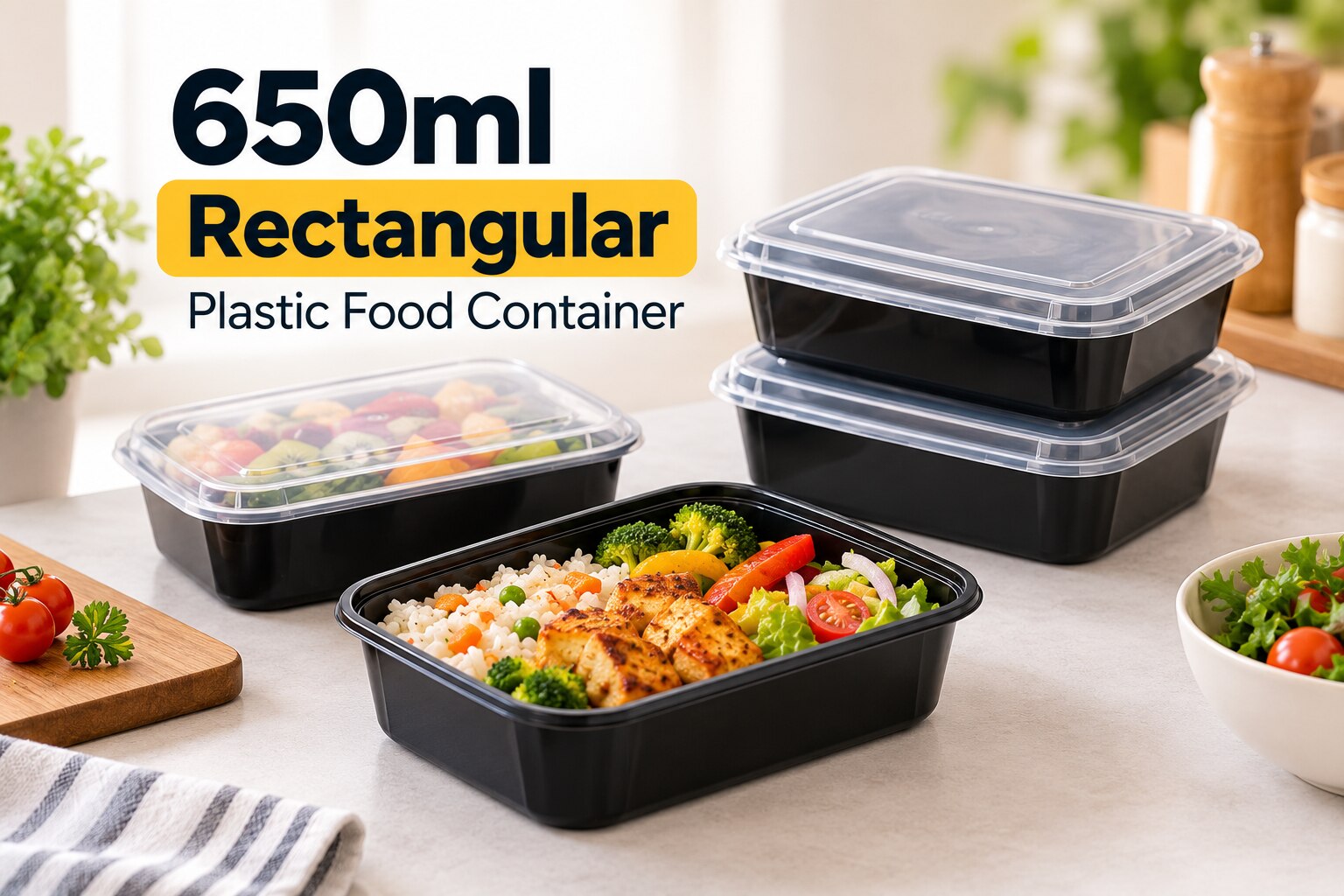
A 650ml pack holds a nominal 0.65 litres, but that figure does not tell you the practical serving size, food compatibility or lid performance. By the end, you will know which foods fit, how much headspace to leave, what the rectangular shape changes in storage and delivery, and which tests to complete before ordering.
Key takeaways
- 650ml means 0.65 litres of nominal internal volume, not a fixed serving size.
- Use it for rice meals, curries, salads, snacks and prepared retail foods.
- Check material ratings, lid fit, seal quality and temperature limits before packing.
- Compare Bangalore suppliers using samples, case quantities, documents and delivery terms.
What does 650ml mean in everyday retail use?
A 650ml container holds a nominal internal volume of 0.65 litres. That number is not a guaranteed serving size, nor does it define one universal rectangular shape, wall height, corner radius or lid design.
Brimful capacity means the volume measured up to the rim. Usable selling capacity is lower because you need headspace for:
- Gravy, oil and toppings that can spread into the lid
- Food displacement from rice, large pieces or mixed ingredients
- Lid clearance, so the closure does not press into the food
- Expansion, movement and vibration that can cause leaks during delivery
Two packs labelled 650ml can therefore produce different saleable portions. Ask the supplier for the internal length, internal width, internal height, a dimensional drawing and the method used for its brimful-volume test. Then fill the actual recipe, close the lid and check the practical fill line.
The useful retail question is not “Does this hold 650ml?” but “What volume can I sell without spills, crushed toppings or a fouled lid?” That is the key point in 650ml rectangular plastic food container explained for retailers in Bangalore: capacity labels begin the comparison, while tested fill volume determines whether the pack works.
Which foods fit a 650ml rectangular container?
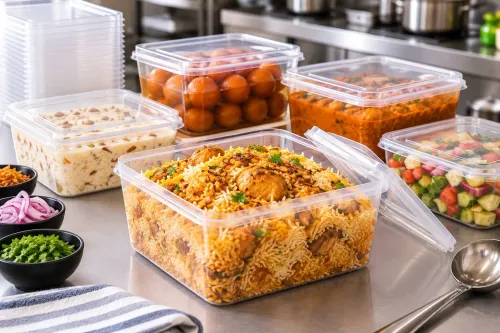
A 650ml rectangular container suits many single-serving meals, but the recipe—not the label—sets the usable portion. These are common 650ml rectangular container uses:
| Food group | Suitable examples | What to check |
|---|---|---|
| Rice meals | Steamed rice, biryani, pulao | Dense rice can fit well; leave room for oil, toppings and lid clearance |
| Noodles and pasta | Stir-fried noodles, pasta with moderate sauce | Test long strands and prevent sauce from fouling the lid |
| Curries | Curry with rice, roti pieces or side dishes | Gravy and large pieces reduce usable capacity |
| Fresh foods | Salads, cut fruit, meal-prep portions | Check layering, condensation and presentation |
| Snacks and bakery | Cut snacks, pastries, brownies and other bakery items | Oversized or delicate pieces can crush against the lid |
| Retail foods | Chilled prepared meals and ready-to-eat portions | Confirm the fill line, label area and closure performance |
Density, sauce level, piece size and presentation matter more than volume alone. A compact biryani portion may fit comfortably, while bulky fried pieces may not.
Avoid filling highly liquid foods to the rim; movement, thermal expansion and displacement can force gravy through the closure. Oversized pieces and foods needing substantial separation between components are poor fits unless the pack includes dividers.
A 650ml pack is not automatically a 650ml saleable portion. Fill the actual recipe, close the actual lid, transport it and inspect for leakage or crushed presentation before setting your retail fill line.
How does the rectangular shape affect packing and presentation?
Flat sides make a 650ml pack easier to arrange when shelf width, refrigerator space or delivery-bag capacity matters. A rectangular food container for retail products also gives labels a longer straight surface and presents the product with a clear front-facing edge.
| Feature | Rectangular 650ml container | Round 500ml tub |
|---|---|---|
| Shelf display | More straight-sided label and shelf-facing area | Curved surface limits label width |
| Refrigerator storage | Units align in rows with fewer side gaps | Round units leave triangular gaps |
| Delivery bags | Packs closely beside other rectangular meals | Gaps appear around the curved walls |
| Carton packing | Bases and lids can nest in orderly columns | Mould design can leave more unused space |
| Stacking stability | Flat edges help maintain aligned stacks | Stacks depend more heavily on lid and rim shape |
Do not compare capacity labels alone. Measure the filled-unit footprint, the nested lid height and the stack height; a larger nominal volume can occupy more space or create a poorer portion. A rectangular base can also make scraping food from corners harder, while those corners demand more attention during hand washing.
Test the actual packed meal on a shelf, inside the delivery bag and in the carton before choosing the format.
Can it hold hot, oily, acidic, chilled or frozen food?
Do not choose a 650ml container for hot, oily, acidic, chilled or frozen food from its capacity alone. The resin, grade, wall thickness, lid and stated temperature range determine whether the pack will soften, warp, leak or transfer odour.
- Investigate polypropylene (PP) for hot filling, reheating or microwave use. PP alone does not prove microwave safety: ask for the supplier’s microwave statement and follow its heating limits.
- Choose PET when clear presentation matters for chilled salads, fruit, desserts and retail foods. Confirm the specific grade’s temperature limit; food-contact compliance does not make PET suitable for hot filling or microwaving.
- Check the stated limitations for polystyrene and expanded polystyrene before using them with hot, oily or reheated foods. Low cost and rigidity do not establish heat suitability.
- For acidic foods such as tomato curry, citrus fruit or vinegar-based salad, request compatibility evidence for the actual food, contact time and temperature. Acidity can expose weaknesses that a water test misses.
Freezer use also needs a confirmed freezer range. A container approved for food contact is not automatically approved for freezing, reheating or repeated reuse. Ask whether hand washing is allowed, how many reuse cycles are supported, and whether the lid remains secure after chilling and thawing.
Before ordering, request:
- Exact material and grade
- Wall specification and temperature range
- Microwave and freezer statements
- Food-contact declaration and migration or conformity evidence
- Hand-washing and reuse guidance
- Compatibility with oily and acidic foods
For Indian purchases, ask for documentation relevant to the intended use under FSSAI Packaging Regulations, not merely “food grade plastic.”
How should you verify the lid and compare Bangalore suppliers?
A lid that fits one 650ml base is not automatically suitable for another. Match the footprint, corner shape, rim profile and closure type; then check full snap engagement, lid inclusion, leak resistance, condensation and pop-off under stacking pressure. A sealed retail pack also needs tamper evidence, not merely an ordinary snap lid.
Test a sample with the actual recipe, not room-temperature water:
- Fill to the intended line and close immediately.
- Invert and shake the container.
- Stack filled units to the expected delivery or display height.
- Hold them at the intended hot or chilled temperature.
- After cooling or transport, inspect seepage, deformation, staining, odour transfer and label adhesion.
| Supplier check | What to compare | Why it matters |
|---|---|---|
| Product specification | Material, food-contact declaration, migration or conformity evidence under FSSAI Packaging Regulations, lid inclusion, tamper evidence and temperature use | “Food grade plastic” alone does not identify suitability |
| Logistics | Pieces per carton, carton dimensions, gross weight, minimum order quantity and lead time | Nesting efficiency changes freight and storage cost |
| Commercial terms | GST invoice, replacement policy for cracked or warped pieces and delivered cost | A low per-piece quote can become expensive after defects and delivery |
When requesting quotes from a plastic food container supplier in Bangalore, state the food, temperature, colour, lid requirement, label or coding needs and delivery location. Ankita Enterprises can provide these specifications for comparison, but sample testing must decide whether the pack works.
Related product
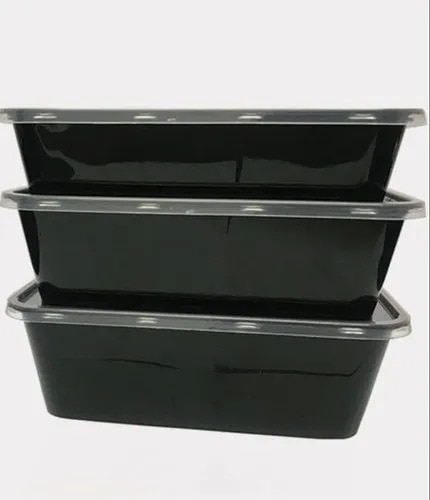 | Food Container 650ml Rectangular Plastic Food Container We are the Dealers of Food Containers, Sugarcane Bagasse Products, Brown Paper Bags & Pouches, Corrugated Pizza Box, Disposable Hand Gloves,... View product → |
Frequently asked questions
What does 650ml mean in everyday retail use?
650ml means a nominal internal capacity of 0.65 litres. It does not guarantee a serving size or specify the container’s exact dimensions, wall height or lid design.
Which foods fit a 650ml rectangular container?
It suits single portions of rice meals, curries, noodles, pasta, salads, snacks and other prepared retail foods, provided the food volume and shape fit without overfilling.
How does the rectangular shape affect packing and presentation?
Straight sides and corners use shelf and delivery space efficiently, while the larger visual surface helps separate or display food. Check corner access, stacking stability and headspace before choosing it.
Can a 650ml rectangular container hold hot, oily, acidic, chilled or frozen food?
Only use it when the container and lid are rated for the food and temperature involved. Confirm the material, temperature range, oil and acid resistance, and freezer suitability with the supplier.
How should you verify the lid and compare Bangalore suppliers?
Test the lid on filled samples for fit, leakage, stacking and opening force. Compare suppliers by material documentation, batch traceability, case quantity, replacement policy and delivery terms.
Keywords