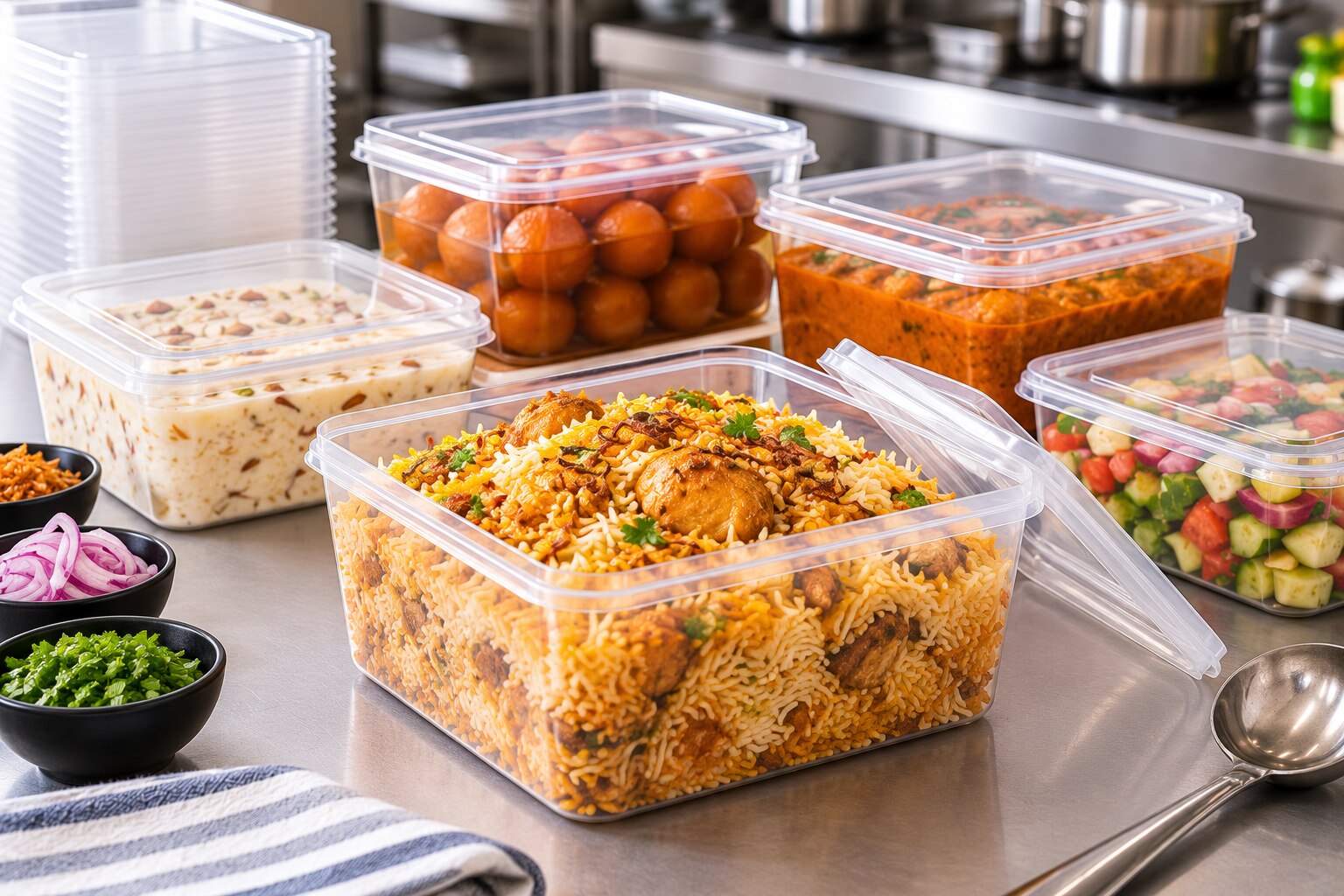
A 2000ml label tells you the container’s nominal volume, not how much biryani, curry or gravy you can safely send in it. To pack large portions reliably, you need to match usable capacity, food type, material, lid performance, filling method and delivery conditions.
Key takeaways
- Fill 1,600–1,800ml, leaving 10–20% headspace.
- Use square containers for layered meals, rice and stackable bulk orders.
- Check food-contact material, lid fit, dimensions and leak resistance before buying.
- Test sealed containers through tilting, stacking and Bangalore delivery conditions.
What does 2000ml capacity mean in an actual food portion?
Treat 2,000 ml as the container’s internal volume, not the amount you should dispatch. For 2000 ml square food container usage, leave about 10–20% headspace for the lid, steam, sauce movement and tilting during delivery. That gives roughly 1,600–1,800 ml of practical fill for rice, biryani, noodles or a mixed dry meal.
Hot or liquid-heavy food needs more clearance. Fill gravy, curry or soup to about 1,400–1,600 ml unless the lid has a proven anti-leak seal and the pack will remain upright. A full container can foul the lid, force liquid through the rim and spill when a rider brakes or turns.
The volume does not tell you the weight. Two litres of loose fried snacks, compact rice and curry will weigh differently because density and trapped air vary. Set a target fill weight for each menu item, then check it against the measured internal capacity rather than relying on the printed label.
A practical portion might be a family-size rice meal with a separate sauce cup placed inside only if it still leaves the required clearance. Do not assume two containers marked 2000 ml hold the same quantity; compare internal length, width, height and usable volume before buying.
Which foods suit a large square container, and how does its shape affect packing?
Biryani, pulao, rice meals, noodles, fried snacks, cut fruit, salads, curries and mixed catering portions suit large square container packing. The broad base supports family portions and layered meals without forcing food into a tall, narrow shape.
A liquid-heavy curry or gravy still needs a leak-resistant lid, movement allowance and headspace; a 2000ml label does not make a container safe for a full two-litre fill.
| Format | Packing advantage | Trade-off |
|---|---|---|
| Square | Fits rectangular shelves, delivery crates and cartons with less unused space; corners help separate rice, sides and sauces | Corners are harder to scrape clean and can concentrate stress if the pack is dropped or squeezed |
| Round | Easier to stir, scoop and empty completely; pressure distributes more evenly around the wall | Leaves gaps in square crates and shelves, reducing stacking alignment |
Choose square when you need dense, stable stacking or want separate meal components to remain organised during dispatch. Choose round when customers will stir or scrape the container, or when the food is mainly sauce and complete emptying matters more than carton efficiency.
Leave room below the lid for steam, movement and closing. Filling to the rim causes lid fouling, pressure-driven leakage and spillage when a delivery pack tilts. State both the container’s nominal volume and the target fill weight, because two litres of rice, gravy and fried food do not weigh the same.
How should you fill, close and label the container?
Fill by controlled weight or volume, not by sight. A 2000ml rating is nominal capacity, so set a target fill weight for each menu item and leave headspace for the lid, steam and movement.
Search wording such as “20000ml square disposable container process for food businesses in bangalore” can create a costly size error: confirm that the order says 2000ml.
- Inspect each container for cracks, deformation, dirt and a compatible lid. Check the food-contact documentation for the exact material, colour, coating, adhesive and lid combination.
- Set the container level on a stable packing surface. For dry rice, biryani, noodles or snacks, distribute the food evenly and keep it below the rim. Add oily foods without scraping oil across the sealing area.
- For curry or gravy, fill slowly to prevent splashing and leave extra headspace if the pack will tilt during delivery. Keep separate sauces in a sealed inner cup when they would soak or loosen the main food.
- Pack hot food only in a container rated for its filling temperature. Match the pack to the approved cooling method; a sealed large pack can cool slowly at its centre, while condensation under the lid increases leakage.
- Wipe the entire rim clean, fit the matching lid and engage every closure around the perimeter. A lid resting on the rim is not a seal.
- Check sample packs for leaks and inversion failure, then label the product, packed date and time, batch or lot, storage instruction and use-by time. Stack within the specified limit and dispatch upright.
What must you verify about the material, lid and dimensions before buying?
Approve a disposable square container for bulk food only after matching its material, construction, lid and measured dimensions to the product you will pack.
1. Request food-contact documentation for the exact material, colour, coating, adhesive and lid combination. “Food grade” or “compostable” alone does not confirm safety for acidic curry, oily noodles, alcohol-based sauces or hot food. Check the stated temperature range, freezer rating and microwave permission; never infer these from appearance.
2. Compare wall thickness and empty weight, not material name alone. A thin wall can buckle under a heavy rice meal or stacked delivery packs. Ask for the intended fill weight and test a loaded container while warm.
3. Measure internal length, width and height, then record external footprint and nominal versus measured capacity. Two containers marked 2000ml can hold different usable amounts, occupy different shelf space and stack poorly. Check nesting depth and the maximum safe stack height.
4. Inspect the rim profile for a continuous, flat sealing land without warping. Match it to the correct lid; a loose cover or lid that merely rests on the rim is not leak protection.
5. Ask how the closure works and how much force it needs around the full perimeter. Confirm the lid stays locked after filling, wiping the rim and tilting the pack. Include a sample leak and inversion test in approval, especially for gravy.
How do you test and specify a container for Bangalore delivery?
A 2000ml label is not enough for procurement: record usable capacity, internal dimensions, external footprint, height, empty weight and intended fill weight for each food. Confirm the exact material, colour, coating, adhesive and lid combination through food-contact documentation; “food grade” alone does not prove suitability for hot, oily or acidic food.
Use this specification checklist for a disposable square container for bulk food:
- Lid model, rim fit, closure force and leak-test method
- Temperature limits, microwave and freezer status
- Nesting depth, carton quantity and maximum recommended stack
- Carton dimensions and a secondary pack that restrains sideways movement without pressing lids
- Acceptance criteria for cracked corners, warped lids, seal gaps and leakage
| Test | How to run it | Pass condition |
|---|---|---|
| Upright leak test | Fill each sample to the planned weight, close, and hold upright | No seepage or lid lift |
| Tilt test | Tilt filled packs gradually, then inspect corners and rim | No gravy escape or closure opening |
| Stack test | Load the intended carton or crate height | Lids remain flat and packs do not buckle |
| Delivery simulation | Place packs in a delivery bag, expose them to road vibration, handling and temperature changes | No broken container, displaced lid or wet carton |
Test chilled food for condensation and wet cartons during monsoon conditions. Include two-wheeler movement, not just shelf storage. Ankita Enterprises can help compare samples, but approve only the exact material-and-lid combination that passes your trial.
This is the 2000ml square disposable container process for food businesses in Bangalore: document the result by supplier, batch, fill weight and carton configuration before ordering at scale.
Related product
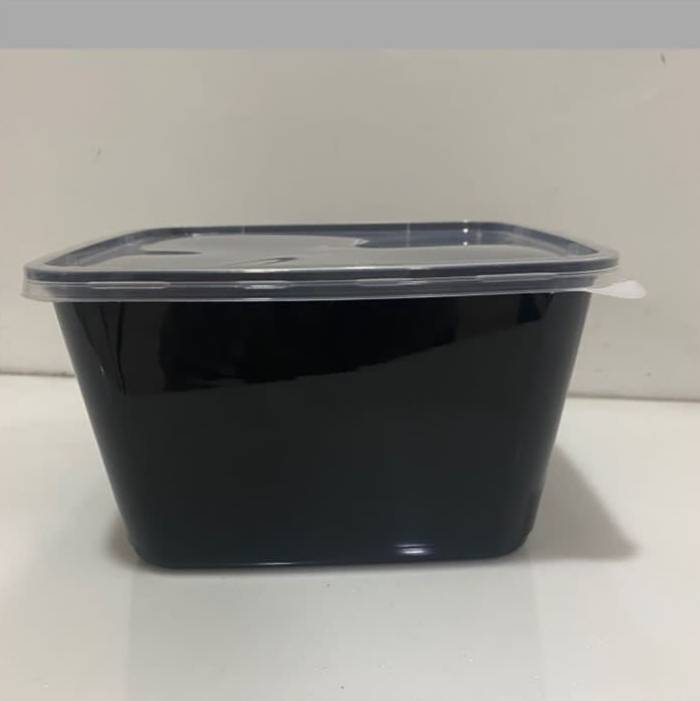 | Food Container 2000ml ₹22 square Container Black View product → |
Frequently asked questions
What does 2000ml capacity mean for an actual food portion?
It means the container’s internal volume. Leave 10–20% headspace, giving a practical fill of about 1,600–1,800ml.
Which foods suit a large square container?
Rice, biryani, noodles, mixed dry meals and other foods that benefit from broad, stackable packing suit the format.
How should you fill, close and label a 2000ml square container?
Fill below the rim, control steam and sauce movement, close the lid evenly, then label contents, date, allergens and handling instructions.
What must you verify before buying a large square container?
Verify the food-contact material, lid compatibility, internal and external dimensions, seal quality, temperature limits and stacking performance.
How do you test a container for Bangalore delivery?
Fill it with the intended food, seal it, tilt and stack it, then test for leaks, deformation, lid release and temperature-related problems.
Keywords