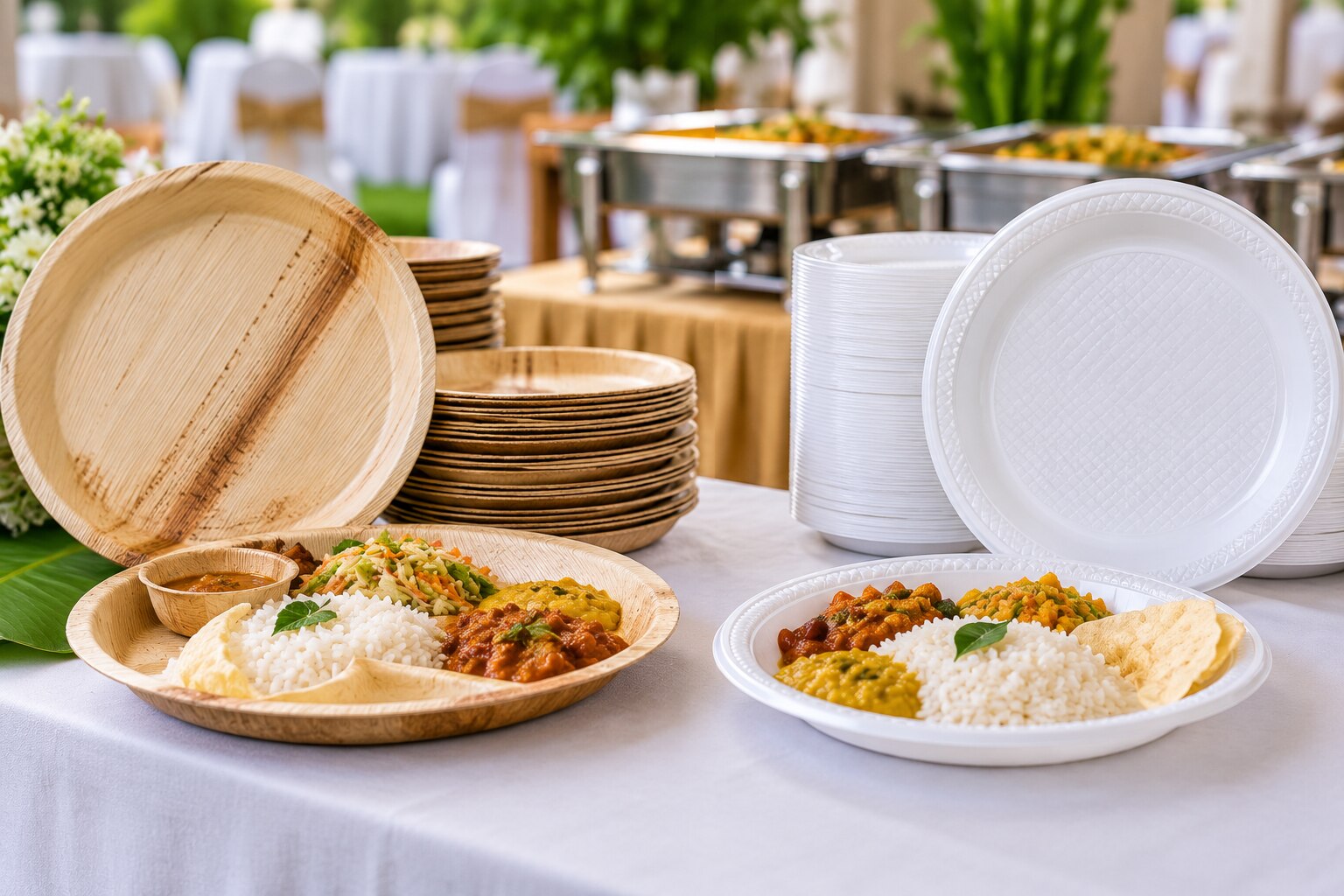
The right plate depends on the menu, serving time, carrying distance and disposal route—not simply on whether it is labelled areca or plastic. By comparing capacity, food performance, legal status, handling and delivered cost, you can specify a plate that works for the event instead of discovering its weaknesses at the buffet.
Key takeaways
- Compare flat inner diameter, rim depth and bowl profile—not only the 12-inch label.
- Use compartment plates for gravies, sides and faster buffet service.
- Check plastic plates against Karnataka’s single-use plastic restrictions before ordering.
- Calculate plates for guests, service rounds, breakage and a practical reserve.
Choose by menu and service conditions, not by the 12-inch label
A 12-inch label does not tell you how much food a plate can carry. Compare the flat inner diameter, rim depth, bowl profile, compartments, piece weight and packed stack height before choosing an areca plate versus plastic plate.
| Feature | Shallow 12-inch plate | Deeper plate or permitted non-plastic alternative |
|---|---|---|
| Flat inner area | Smaller space for rice and sides | More usable separated surface |
| Rim and bowl profile | Suits dry snacks and short meals | Contains curry, sambar and oily food better |
| Piece weight and stack height | Lighter, easier to crush or tip | Heavier and stronger in a long queue |
| Compartments | Little separation between foods | Keeps rice, vegetables, bread and dessert apart |
Use a shallow plate for dry snacks or a meal eaten quickly. Rice, sambar, curry, vegetables, bread and dessert need a deeper profile plus enough separated surface area; a wide rim does not replace usable depth.
Specify the service conditions before ordering:
- Event duration and maximum guest dwell time
- Food temperature and wet-food quantity
- Carrying distance, including outdoor movement
- Required stack strength and packed stack height
- Disposal route and segregation capacity
For a long queue serving hot, oily or liquid-heavy food, test a deeper, heavier-gauge areca plate or a permitted non-plastic alternative with the actual menu. A nominal 12-inch diameter is not a universal capacity claim.
Will a 12-inch areca plate hold a complete catering meal?
Yes, a 12 inch areca plate for catering can carry a normal Bangalore meal of rice, sambar, curry, vegetables, bread and dessert without crowding.
Pressed areca leaf handles moderate wet food well, but it is not a leak-proof tray: watery gravy, hot oil, a weak fibre point or 30–60 minutes of contact can cause seepage, rim collapse or rejected plates.
The 12 inch areca leaf plate versus plastic plate for catering in bangalore comparison changes with the menu and holding time.
| Option | Hot meal performance | Main failure risk |
|---|---|---|
| Pressed areca leaf | Suitable for ordinary service and moderate gravy | Softening, seepage or rim collapse after prolonged wet contact |
| Rigid plastic | Holds liquid and resists soaking more consistently | Disposable versions are not a compliant default for public catering |
| Deep, heavier-gauge areca | Better for oily, liquid-heavy meals and longer queues | Higher weight and cost, with lot-to-lot quality variation |
Run this acceptance test before ordering:
- Load the actual menu at serving temperature, including the planned quantities of rice, sambar, curry, vegetables, bread and dessert.
- Hold each plate for the maximum guest dwell time, especially 30–60 minutes.
- Lift it one-handed, carry it over the planned distance and stack it as staff will.
- Record softening, leakage, rim collapse and breakage.
Do not wash intact areca plates for reuse. Water absorption damages the fibres, while washing introduces sanitation problems that a normal kitchen process may not remove; specify them as single-use.
What kind of plastic plate is legal and practical for Bangalore events?
A conventional disposable plastic plate is not a compliant default for public catering in Bangalore. India’s single-use-plastic prohibition covers disposable plastic plates, cups, glasses, forks, spoons, knives, straws, trays and stirrers from 1 July 2022.
Reusable plastic plates remain practical when the organiser has washing, storage and return controls; plastic-coated paper plates need coating and intended-use verification, not an automatic exemption.
| Option | Practical position | What differs |
|---|---|---|
| Reusable plastic | Permitted when collected and washed for reuse | Rigidity, stack life and wash durability depend on polymer and design |
| Disposable PP | Not a default procurement choice for public events | Usually tougher and more heat-tolerant than PS, but confirm food-contact use and legal status |
| Disposable PS | Avoid as a conventional disposable plate | Rigid and light, but more brittle and less suitable for hot food; recycling routes are limited |
| PET or plastic-coated paper | Treat as a separate specification | Rigidity, heat limits, coating composition and recycling route vary; the word “plastic” proves none of them |
For disposable plates for catering in Bangalore, request these documents before comparing prices:
- Exact polymer or coating material, not merely “food grade” or “eco-friendly”
- Food-contact declaration showing suitability for the intended food, temperature and duration, supported by FSSAI packaging compliance records and relevant migration or contaminant information
- Intended-use statement, including hot, oily or liquid food limits
- Compostability certificate identifying IS/ISO 17088 or another applicable standard
Food-contact safety and compostability are separate claims. IS/ISO 17088 addresses certified compostable plastics; it does not automatically certify moulded areca products, which require material and treatment declarations.
How plate design changes buffet handling, transport and waste
A deep rim contains sambar and curry; a textured surface improves grip on oily rice and vegetables. Compartments keep rice separate from gravy, while a heavier plate stays stable in outdoor wind but adds freight and carrying effort.
| Feature | Areca leaf plate | Reusable plastic plate |
|---|---|---|
| Rigidity and carrying | Resists ordinary meal loads but can crush or chip; one-handed carrying needs a timed test | More rigid and reliable for long queues and one-handed carrying |
| Stacking and transport | Larger packed volume; pressure can warp or crack pieces | Compact, uniform stacks with fewer transport rejects |
| Soaking and grip | Fibre softens with wet food; texture can improve grip until saturated | Does not soak; smooth surfaces can make oily food slide |
| Wind and stability | Greater weight helps outdoors, but a damaged rim fails quickly | Lower or higher weight varies by design; test stability on the actual tables |
Treat areca leaf event plates as vulnerable stock. Keep cartons off the floor, protect them from rain and condensation, ventilate storage, and rotate by lot. At receiving, count cracked, warped and visibly contaminated pieces instead of accepting the nominal quantity.
Your delivered-cost sheet must include freight volume, storage space, rejected pieces, breakage, waste collection and sorting labour. A clean, segregated stream is essential: confirm that a receiving composting facility accepts soiled areca plates before calling them an environmental improvement. Mixed with plastic-lined packaging, foil and sachets, they are unlikely to become clean compost feedstock.
Build a plate specification and order quantity before you buy
Set the purchase around the actual menu, not the catalogue diameter. For a 12 inch areca plate for catering, record these specifications before requesting quotes:
- Usable inner diameter, depth, bowl profile and compartment count
- Piece weight and packed stack height, including carton dimensions for freight and storage
- Leaf-treatment or material declaration, storage period and acceptable defect rate
- Food-contact declaration and the timed menu test: load hot food, hold it for 30–60 minutes, lift it one-handed, carry it the planned distance, stack it, and record softening, leakage, rim collapse and breakage
Ask an areca supplier to confirm in writing that the plate has no plastic coating, PFAS-based grease treatment, formaldehyde resin or undisclosed binder. For plastic, require the exact polymer, such as PP, PS or PET, plus food-contact compliance documents and intended-use information.
Compare freight volume, storage space, rejects, waste collection and sorting labour, not just unit price. Ankita Enterprises can be one local sourcing option for checking these details and delivered quantities.
| Planned quantity | Calculation |
|---|---|
| First servings | Confirmed guest count × one plate |
| Second servings | Expected repeat servings × one plate |
| Staff meals | Staff count × planned meals |
| Controlled allowance | Breakage, contamination and rejected pieces from your trial or past records |
Do not invent one universal wastage percentage. Record the allowance separately from food demand, then adjust it after each event. That makes the areca plate versus plastic plate decision defensible.
Related products
 | Disposable Plates 10inches Areca Leaf Round Plate We are the Dealers of Food Containers, Sugarcane Bagasse Products, Brown Paper Bags & Pouches, Corrugated Pizza Box, Disposable Hand Gloves,... View product → |
 | Disposable Plates We are the Dealers of Food Containers, Sugarcane Bagasse Products, Brown Paper Bags & Pouches, Corrugated Pizza Box, Disposable Hand Gloves,... View product → |
Frequently asked questions
Will a 12-inch areca plate hold a complete catering meal?
It can hold a complete meal when the plate has enough usable inner diameter, rim depth and a suitable bowl profile. Check the plate with the actual rice, curry, sides and dessert portions before ordering.
What should you compare between areca leaf and plastic catering plates?
Compare rigidity, leak resistance, heat handling, compartments, piece weight, packed stack height, disposal route and compliance with Karnataka’s single-use plastic rules.
How does plate design affect buffet handling and waste?
Raised rims and compartments help separate gravies and sides, while stable shapes reduce spills during transport and service. Lightweight or poorly stacked plates increase handling problems and waste.
How many disposable plates should you order for a Bangalore catering event?
Start with the guest count, then add plates for service rounds, staff, breakage and unexpected attendance. Base the calculation on whether guests receive one plate or return for additional rounds.
Related product
 | Disposable Plates We are the Dealers of Food Containers, Sugarcane Bagasse Products, Brown Paper Bags & Pouches, Corrugated Pizza Box, Disposable Hand Gloves,... View product → |
Keywords