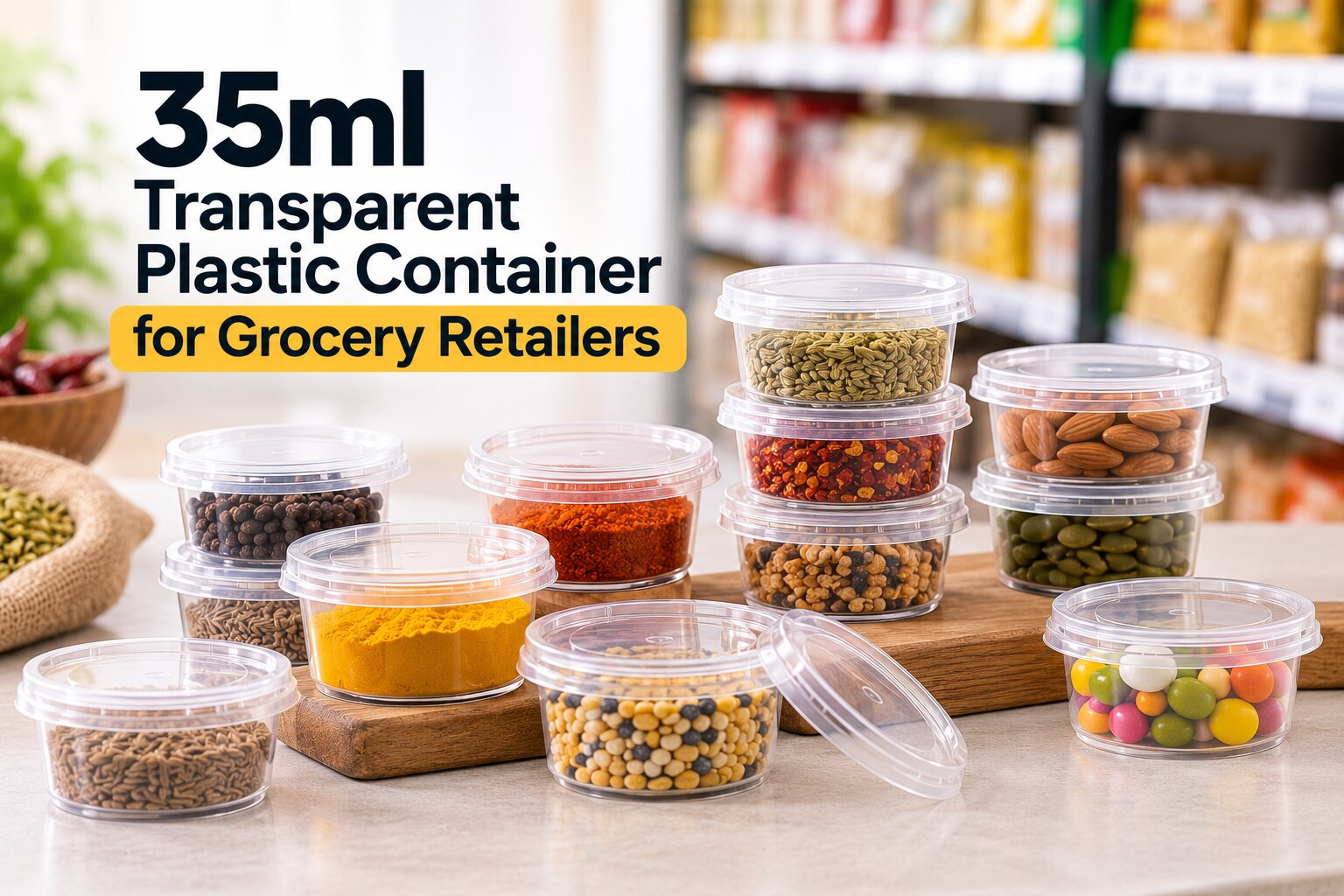
A quoted 35ml capacity does not tell you whether a container will hold 35ml of spice, sauce or seeds safely on a retail shelf. By checking usable fill volume, dimensions, resin, closure, sealing method and compliance documents, you can choose a pack that fits the product and survives Bangalore distribution.
Key takeaways
- Approve filled usable volume, not the 35ml brim capacity.
- Use PET for clarity; choose PP when heat resistance matters.
- Test the closed pack upside down before approving a closure.
- Request food-contact documents, batch details and a specification sheet.
Start with usable capacity, dimensions and product fit
A nominal 35 ml container may hold 35 ml only to the brim, leaving no room for a lid, product movement or spill control. For a 35ml container for retail packaging, approve the usable filled volume instead.
The question “which 35ml transparent plastic container for suits grocery retailers in Bangalore” is answered by testing the real product in the real closure, then checking filled-pack dimensions, stacking and local delivery handling.
Ask the supplier for:
- Height, maximum width, base diameter, opening diameter, wall thickness, neck profile and dimensional tolerances
- Brimful capacity, usable fill volume, container and lid weights, and the headspace recommendation
- Closure fit, carton quantity, storage limits and lot traceability
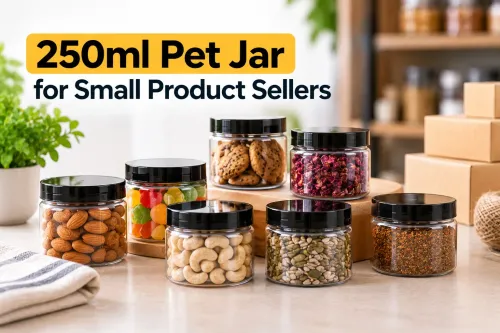
Fill a sample with the intended spices, seeds, dry fruits or topping. Confirm that the product enters without bridging, leaves room for closure, and does not spill when shaken or inverted. Bulky pieces need a wider opening, thicker walls or a larger format.
| Shape | Best fit | Retail consequence |
|---|---|---|
| Straight-sided tub | Spices, toppings and sample portions | Efficient stacking and broad label area |
| Round jar | Seeds, dry fruits and condiments | Easy handling, but less efficient shelf and carton use |
| Square or rectangular base | Stable small packs and promotional portions | Better shelf stability and label space |
A narrow opening suits powders and fine seeds; irregular dry fruits can bridge across it. Approve by filled volume, not catalogue capacity alone.
Match PET or PP to the grocery product and process
PET suits dry spices, seeds and toppings when shelf visibility and moderate oxygen or moisture barrier matter; PP suits products needing greater heat tolerance and flexing. A 35ml transparent plastic container in Bangalore still needs evidence for the exact food, resin and closure: clear plastic alone does not prove food-contact suitability.
| Resin | Strength | Watch for |
|---|---|---|
| PET | High optical clarity; useful oxygen and moisture barrier | Confirm compatibility with oily foods, acidic condiments, sauces and hot-fill conditions |
| PP | Better heat tolerance and flexibility | Lower optical clarity; confirm performance under refrigeration, freezing and repeated handling |
Ask for written limits covering hot-fill temperature, refrigeration, freezing, microwave use, dishwasher cleaning and reuse. Do not infer them from capacity or appearance. For food-contact approval, request a current declaration and conformity or migration documents naming the resin, colourant, additives, closure and any recycled content.
Light-sensitive spices, oils and sauces may need an opaque label or outer carton despite the display benefit of transparency.
Test a filled sample under the proposed storage and transport conditions before ordering. Check for:
- Distortion, cracking or discolouration
- New odour or product interaction
- Softening after heat exposure or brittleness after chilling
- Changes in the product’s colour, smell or texture
A sample that survives room-temperature storage can still fail after hot filling, refrigerated delivery or vibration. Reject the pack until the complete container-and-closure system passes those conditions.
Choose the closure and prove it will not leak
Choose the closure with the product and handling routine, not separately from the 35ml container. A snap-fit lid controls dust but does not prove leak resistance; a screw cap supports repeated opening, while heat-seal film or foil adds tamper evidence and improves leakage control when the flange, liner and sealing equipment match.
| Option | Main benefit | Limitation |
|---|---|---|
| Snap-fit lid | Fast application and dust control | Needs an inversion and transport test; it is not automatically leakproof |
| Screw cap | Repeated opening and closing | Requires correct thread fit and verified closure torque |
| Hinged lid | Lid stays attached during dispensing | Hinge or rim defects can prevent a continuous seal |
| Heat-seal film or foil | Tamper evidence and stronger barrier | Needs a flat flange, compatible liner and matched sealing equipment |
Before ordering, ask whether the lid is included in the quoted price. Confirm that the lid and container are sold as matched components, and check that replacement lids use the same dimensions and resin. A small plastic container for grocery stores can become unusable after a minor rim mismatch.
Test the filled pack with the actual liquid or semi-liquid:
- Fill to the intended level, close or seal it, then invert it.
- Shake it and expose it to expected vibration and temperature conditions.
- Inspect the container, closure and outer carton for wetness or staining.
- Check lid retention, seal continuity, flange flatness and closure torque.
Reject verbal “leakproof” claims without recorded test results.
Compare the 35ml format with pouches, jars and larger packs
A 35ml rigid pack suits high-value, small servings that need clear display and controlled handling: spice blends, seeds, dry-fruit samples, toppings, condiments, tasting portions and promotional trial packs. It is a poor fit when scooping, headspace or repeated dispensing demands a wider opening.
| Option | Main advantage | Better choice when | Main limitation |
|---|---|---|---|
| Sachet or laminated pouch | Low material use and flexible filling | You need low-cost samples, sauces or irregular quantities | Less shelf structure, weaker stackability and greater puncture or leakage risk |
| PET jar | Strong shelf presence, clarity and larger label area | You sell larger quantities or want visible product presentation | Higher case cube and more plastic than a 35ml pack |
| Hinged box | Easy access for dry, non-leaking portions | The product is chunky, dry and dispensed by hand | Unsuitable for liquids and oily products |
| 100ml or 250ml container | More headspace, scooping room and serving capacity | The product bridges a narrow opening or needs frequent use | More shelf and carton space |
Compare filled-pack height, width and base footprint, not empty containers alone. Record carton count, case cube, stackability, label area, display clarity, breakage and leakage after a Bangalore delivery route.
A wider opening or flexible pouch usually beats a 35ml container for sauces, oily products, irregular dry goods and frequent dispensing. For a small plastic container for grocery stores, choose the format with the lowest total handling and rejection cost, even when its empty-pack price is higher.
This is the practical test for a 35ml transparent plastic container in Bangalore.
Verify compliance, labelling and the supplier specification sheet
If your buying question is “which 35ml transparent plastic container for suits grocery retailers in Bangalore”, use the supplier specification sheet—not the product title—to decide. For a 35ml transparent plastic container in Bangalore, request these details before approving a purchase:
- Brimful capacity and usable fill volume
- Resin, colourant, additives, recycled content and applicable Indian Standard
- Wall thickness, dimensional tolerances, opening dimensions and neck profile
- Container weight, lid weight, sealing compatibility and storage temperature limits
- Carton quantity, batch or lot number and traceability records
Food-contact evidence must cover the complete system: container, lid, liner, seal, food-contacting ink or adhesive, and recycled content. Ask for a current food-contact declaration plus conformity or migration test documents under the Food Safety and Standards (Packaging) Regulations, 2018.
The document should identify the polymer standard, such as IS 10910 for polypropylene or IS 10146 for polyethylene, rather than saying only “food grade”.
| Check | What to confirm | Failure risk |
|---|---|---|
| Label | Net quantity, packer or importer, MRP and required Legal Metrology declarations | Non-compliant retail pack |
| Plastic obligations | EPR responsibility and current specified single-use-plastic restrictions | Delayed launch or enforcement exposure |
| Label area | A label fits without covering the closure or batch marking | Unreadable or incomplete information |
Ankita Enterprises can provide matched samples for comparing specifications, lid availability and carton quantities before you assess Bangalore delivery, storage space and replenishment reliability. Test the filled sample with its actual label and closure.
Frequently asked questions
How much product fits in a nominal 35ml container?
A 35ml rating usually refers to brimful capacity. Check the usable filled volume after allowing space for the lid, product movement and spill control.
Should grocery retailers choose PET or PP for a 35ml container?
Choose PET when high transparency and display appeal matter. Choose PP when the product or process needs greater heat resistance or a more flexible container.
How can you check whether a 35ml container closure will leak?
Fill the container with the intended product or a comparable test liquid, close it to the specified torque, store it in its shipping orientation, then turn it upside down and inspect the lid, seal and threads.
When is a pouch, jar or larger pack better than a 35ml container?
Use a pouch for lower material use and compact storage, a jar for repeated access or a wider opening, and a larger pack when 35ml creates excessive handling or packaging cost.
What documents should a grocery retailer request from the supplier?
Request the specification sheet, food-contact declaration, material identification, capacity and dimensions, closure details, batch or lot traceability, and documents needed for labelling and regulatory review.
Keywords