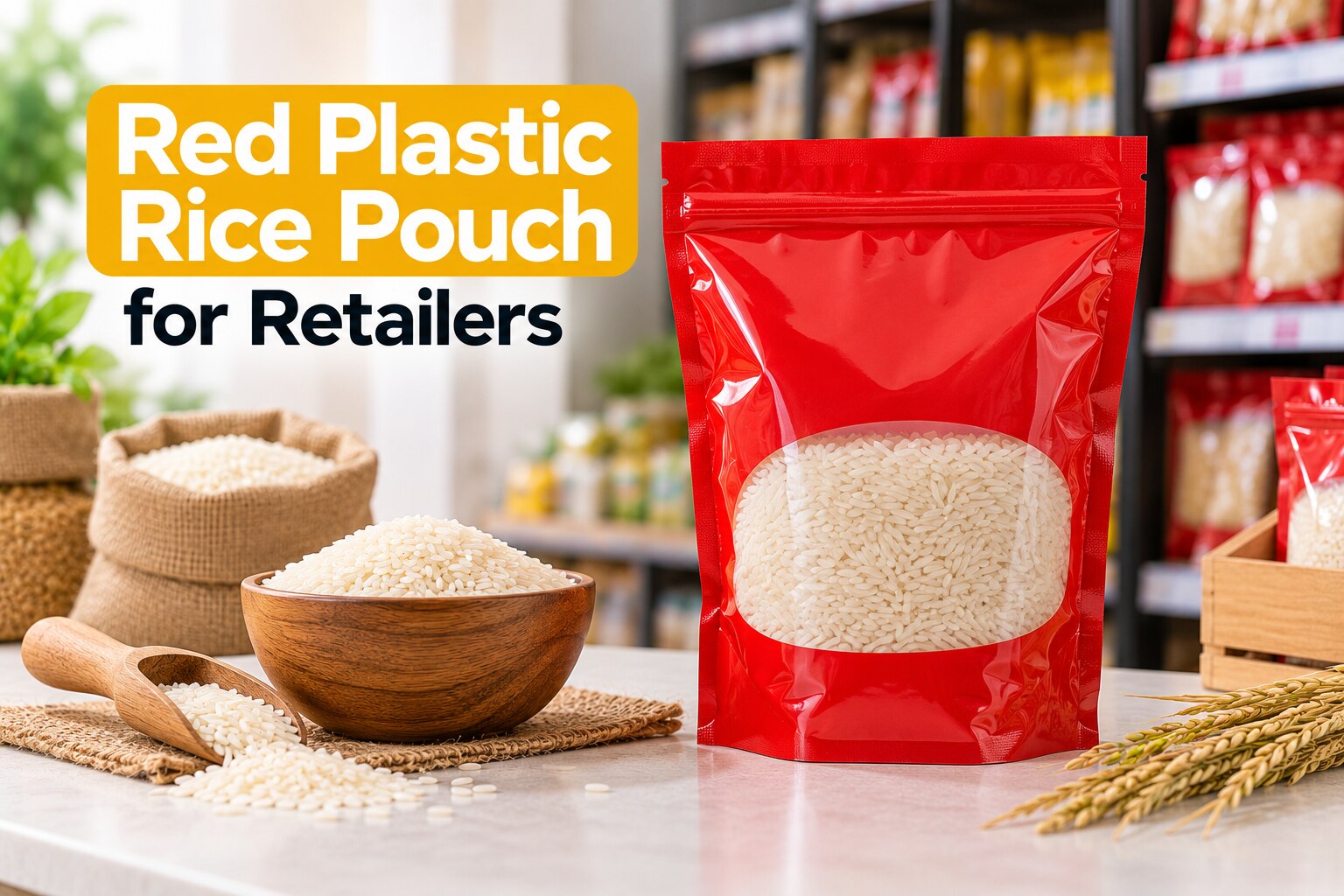
A red pouch can improve shelf visibility, product coding and small-pack merchandising, but its colour says nothing about moisture protection, puncture resistance or seal strength. By the end, you will be able to compare the pouch’s cost per saleable kilogram, qualify its construction, choose suitable pack sizes and decide whether it earns a place in your Bangalore retail operation.
Key takeaways
- Use red pouches for shelf visibility, light protection and fast product identification.
- Choose 500 g to 2 kg pouches for convenience; use stronger construction at 5 kg.
- Test seals, drop resistance, label adhesion and filled-pack handling before stocking.
- Ask suppliers for food-contact details, pouch specifications, samples and consistent supply terms.
When does a red rice pouch create enough retail value to justify its cost?
A red pouch earns its premium when it does more than change colour. The red plastic rice pouch benefits for retailers in Bangalore include a strong shelf block, quick product-family identification and protection from light, while 500 g, 1 kg, 2 kg and 5 kg packs create price points that a large sack cannot.
These rice packaging benefits matter only if they improve stock rotation, reduce damage or reach a customer segment worth serving.
| Benefit | Commercial gain | Cost or risk |
|---|---|---|
| Shelf blocking | Makes one rice family visible and easier to find | Colour alone does not prove extra sales |
| Opaque film | Reduces light exposure and visual clutter | Hides dust, foreign particles, insect damage and grain variation |
| Small formats | Supports trial, household purchase and faster rotation | Packaging and handling cost per kilogram rises |
| Pack coding | Separates varieties and price points from 500 g to 5 kg | Front labels still need clear variety, grade and batch details |
Calculate landed cost per saleable kilogram, not pouch price per unit:
- Add the pouch, filling labour, labels and sealing time.
- Add rejects, leakage, secondary cartons and delivery damage.
- Divide the total by kilograms that reach saleable stock.
Approve the red pouch when that figure is justified by faster rotation, better light protection, lower breakage or a price point customers will buy. Reject it when you pay more for red printed opacity alone.
Smaller packs can improve convenience and stock turnover, but the extra handling and packaging cost must be recovered in the selling price.
Which rice-selling jobs suit a red pouch, and which need another pack?
Use a red pouch for branded 500 g to 5 kg retail packs, trial sizes, bulk-stock repacking, promotional bundles and local delivery orders. Clean, identifiable small packs add value on two-wheeler routes, where loose or poorly closed bags create complaints. These are practical red rice packaging pouch uses for a plastic pouch for rice sellers.
| Option | Grain visibility | Protection and handling | Reuse, closure and cost |
|---|---|---|---|
| Red plastic pouch | None unless panelled | Light protection; puncture and compression resistance depend on film; stacks neatly when filled evenly | Fast heat seal, limited reuse, moderate cost |
| Transparent pouch | Full inspection | Little light protection; visibility exposes dust and grain variation | Fast heat seal, limited reuse, usually low cost |
| Laminated silver pouch | None | Strong moisture and light protection; good stacking, but seals and laminate can split under abuse | Fast seal, limited reuse, higher cost |
| Paper pouch | Partial or none | Good print surface, weaker against moisture and punctures | Slower closure, limited reuse, variable cost |
| Woven polypropylene sack | None or printed | Strong for heavy movement and stacking; less suited to small retail presentation | Stitching or tying is slower; reusable; economical wholesale choice |
| Zipper pouch | Visible only if clear | Convenient opening, but zipper area adds leakage and material cost | Reusable, slower to fill and seal |
Choose another pack when buyers need to inspect grain, large sacks lower wholesale handling cost, or the selected film cannot tolerate compression and rough transport. Add a transparent inspection panel, or receive bulk rice through a sampling procedure that records grain condition before opaque packing. A secondary carton also protects small pouches during delivery.
How should you choose pouch size and construction for each rice weight?
Specify the pouch after filling it with the rice you actually sell, not from nominal capacity. Long-grain, broken, parboiled and short-grain rice occupy different volumes, so trial 500 g, 1 kg, 2 kg and heavier fills before ordering.
| Pack weight | Construction starting point | Test |
|---|---|---|
| 500 g | Flat pouch for compact shelf packs | Confirm headspace and seal after air removal |
| 1 kg | Flat or small-gusset pouch | Check upright stability and corner stress |
| 2 kg | Gusseted pouch for easier filling and stacking | Test compression, lifting and transport |
| Heavier | Gusseted or outer sack with an inner pouch | Test pallet or carton load before retail use |
Leave enough headspace for filling, air removal and a reliable seal. Excess space lets rice move, increases bulging and raises transport damage.
Use this specification checklist:
- Name the film polymer and thickness, then request puncture and corner-resistance results.
- Require consistent red pigment, abrasion-resistant printing, and resistance to rice dust and moisture.
- Specify moisture-vapour performance, pinhole limits, polymer structure and, for laminate, the barrier layer; red colour is not a barrier specification.
- Request food-contact marking and a written material specification, including seal width and heat-sealer compatibility.
- Decide whether this is a direct retail pack or an inner liner inside a sack or carton. The retail pouch needs declarations and shelf durability; the liner mainly needs food-safe containment and sealing.
These rice packaging benefits matter only when the construction matches the job. A rice pouch for grocery stores that looks strong but leaks at the seal is false economy.
How do you seal, label and test a rice pouch before committing to stock?
A plastic pouch for rice sellers is ready for stock only after it survives the same filling, storage and Bangalore delivery conditions it will face in use.
Confirm in writing that the film is heat-sealable and compatible with your hand sealer or continuous band sealer; obtain the supplier’s temperature, dwell-time and pressure settings instead of guessing.
1. Fill production samples with the intended rice variety, weigh each pack, remove excess air and brush rice dust from the seal area.
2. Seal at the specified settings, allow the seam to cool, then check seal width and continuity. Reject packs with leaks, pinholes, weak corners or corner splits.
3. Stack sealed samples to the expected warehouse load. Simulate shelf handling, carton movement, two-wheeler delivery and repeated lifting before approving the design.
4. Store samples through an observation period and compare rice moisture, odour, texture and appearance. In Bangalore’s humid conditions, inspect the film, seal and corners for moisture ingress.
5. Apply the intended label or batch sticker and rub it repeatedly. It must stay attached and legible, including product identity, variety, net quantity, lot or batch, dates, packer details and applicable FSSAI information.
Obtain a food-contact declaration and material specification; “virgin plastic” alone proves nothing. Keep printed surfaces away from food, and confirm responsibilities under India’s Plastic Waste Management framework. Judge the red plastic rice pouch benefits for retailers in Bangalore only after production-sample trials pass every check.
What should a Bangalore retailer ask a pouch supplier before buying?
Ask for written specifications and a trial quantity before approving any rice pouch for grocery stores. Use this supplier question list:
- What are the external dimensions, usable capacity and headspace for 500 g, 1 kg and 2 kg of our actual rice variety?
- Is the pouch flat or gusseted, and what film polymer and gauge does it use? Provide moisture-vapour performance, puncture resistance and pinhole controls; red pigment alone proves nothing.
- What seal width, sealing temperature, dwell time and pressure does the film require? Will it run on our hand sealer or continuous band sealer?
- Is there a food-contact declaration and material specification stating that printed surfaces do not touch the rice?
- Can labels, batch stickers and printed information adhere to the surface without peeling or becoming illegible after rubbing?
- What are the minimum order quantity, production lead time and replacement terms for leaking, split or otherwise defective packs?
Ankita Enterprises can be one Bangalore supplier you ask to provide these documents and samples. Pack and seal samples with the intended rice, then check leaks, corner splits, stacking and delivery handling.
Calculate landed cost per saleable kilogram, including rejects and labour. Approve the red pouch only when its shelf, moisture protection and handling gains exceed a transparent or laminated alternative. The real red plastic rice pouch benefits for retailers in Bangalore must be documented: buy it for that advantage, not for red colour alone.
Related product
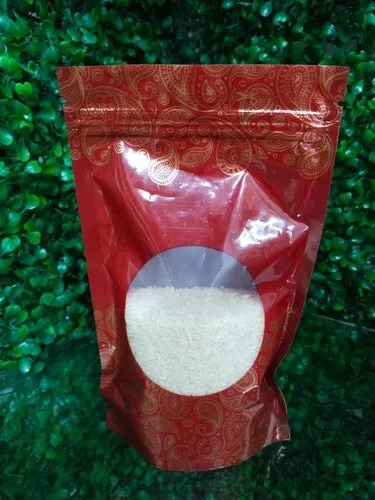 | Packaging Pouch Red Plastic Pouch For Rice Packaging We are the Dealers of Food Containers, Sugarcane Bagasse Products, Brown Paper Bags & Pouches, Corrugated Pizza Box, Disposable Hand Gloves,... View product → |
Frequently asked questions
When does a red rice pouch justify its cost for retailers?
It earns its cost when colour improves shelf blocking and product recognition while the pouch protects rice from light and creates useful 500 g, 1 kg, 2 kg and 5 kg price points.
Which rice-selling jobs suit a red pouch?
Red pouches suit branded retail rice, smaller household packs, promotional ranges and products that benefit from strong shelf identification. Bulk sales, long-distance handling and heavy weights may need woven sacks or stronger laminated packaging.
How should retailers choose pouch size and construction?
Match 500 g, 1 kg, 2 kg or 5 kg to the shopper’s intended purchase. Check film strength, seal width, gusset design, handle requirements and barrier properties before selecting construction.
What should a Bangalore retailer ask a pouch supplier before buying?
Ask for food-contact documentation, material and thickness details, available sizes, sample pouches, seal-setting guidance, printing and labelling options, minimum order quantity, lead time and replacement terms.
Keywords