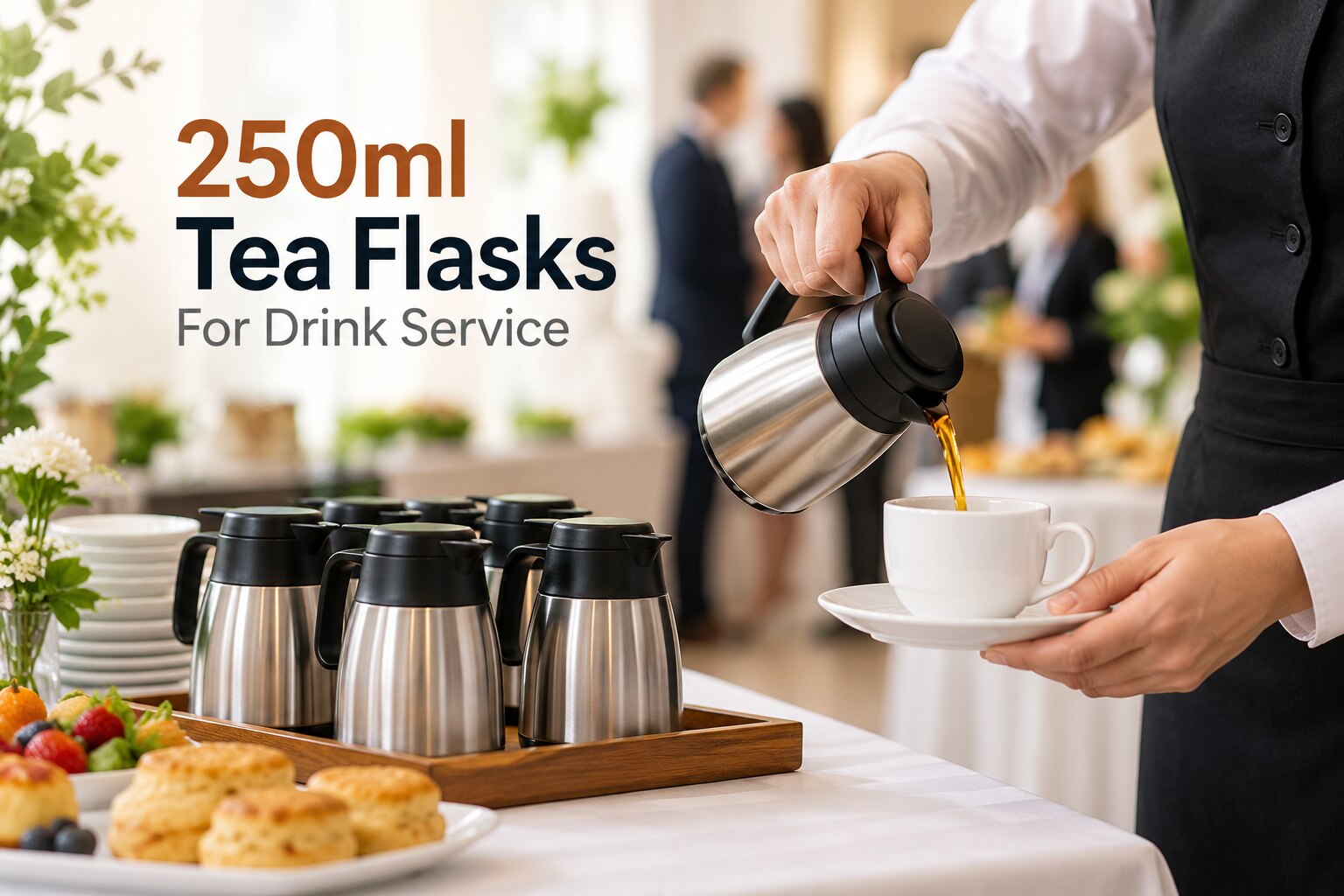
A 250ml label does not tell you how much tea reaches a guest, how long it stays drinkable, or whether the container will survive a crowded service counter. By the end, you will be able to plan portions, organise filling and hand-off, test hot-liquid performance, and specify the right unit for Bangalore conditions.
Key takeaways
- Confirm whether the flask is disposable, plastic, or vacuum insulated.
- Treat each 250ml flask as one full serving unless your menu specifies less.
- Preheat reusable flasks and use lids to reduce heat loss during service.
- Request samples, dimensions, material details, and leak-test results before ordering.
What Caterers Mean by a “250ml Tea Flask”
Ask for a sample and a written specification before ordering: in Bangalore, “250ml tea flask” can mean an insulated paper cup, a lidded plastic cup, or a small reusable vacuum flask. Confirm the product itself, not just the seller’s label.
1. Confirm the material: paperboard with polyethylene or bio-based lining, polypropylene (PP), PET, stainless steel, or another construction. Materials differ in heat tolerance, odour retention, deformation and washing requirements.
2. Confirm the internal capacity and the fill line. “250ml” may describe brim capacity or usable volume, and you will need headspace so the lid does not touch the tea or force spills.
3. Confirm whether it is designed for serving, short-distance transport, or repeated carrying. Individual flasks suit meetings, apartment functions, ceremonies, outdoor service and takeaway counters; they do not replace a bulk tea urn.
4. Inspect the lid. Ask whether it has a pouring or drinking opening, a secure seal and a vent path. A fully sealed lid can splash during filling, while an oversized opening loses heat and spills more easily.
5. Test one filled unit with your actual hot milk tea. Check leakage, lid fit, taste, condensation and handling after filling.
This is the practical meaning of how caterers use 250ml tea flasks in Bangalore: brew and hold tea in bulk, then fill and dispatch individual units close to service time.
How Many Guests Does Each Flask Serve?
A 250ml nominal flask does not automatically provide four servings. Calculate from the tested usable fill after leaving headspace, because overfilling causes lid contact, drips and spills during carrying.
1. Fill one sample flask to the planned level, close its lid and measure the liquid it releases into a jug. Use that figure as usable volume. If the nominal 250ml flask holds 225ml safely, divide 225 by the cup volume.
2. Apply the cup size: 225ml provides three 60ml cups, two 90ml cups or one 120ml cup, with tea left over. If your test allows 240ml, the results become four 60ml cups, two 90ml cups or two 120ml cups.
3. Calculate the order quantity with this formula: guests × cups per guest × cup volume ÷ usable flask volume. Round the answer up. For 100 guests receiving one 90ml cup each from 225ml flasks, 100 × 90 ÷ 225 equals 40 flasks.
4. Add a separate allowance for spills, seconds and late arrivals after calculating the base quantity. Record whether staff will pour one cup per guest or offer refills; that decision changes the order more than the vessel’s printed capacity.
For 250ml tea flask usage in bangalore, plan brewing, holding, filling and dispatch separately. Fill close to hand-off rather than storing the complete order in individual flasks, which increases cooling, leakage and packaging waste. Use bulk urns or insulated beverage dispensers for large-volume holding.
The Service Workflow from Kitchen to Guest
Fill each 250ml unit from an insulated tea container shortly before hand-off, leaving a small headspace rather than topping it to the rim. Keep milk tea stirred in the holding vessel, but do not shake filled flasks; foam and a loose lid create spills.
Check that every rim is clean and every lid is fully seated.
1. Keep flasks upright in shallow crates with dividers, then move the crates from kitchen to service point. Do not stack them under heavy supplies or carry loose units through a wedding crowd; a crushed rim or displaced lid turns a tea flask for catering service into a leak.
2. At a meeting table, buffet station or outdoor counter, open one unit at a time by holding its body below the lid. Pour into the guest’s 60ml, 90ml or 120ml cup, keeping the opening away from clothing and table edges.
If guests take sealed portions, hand over the flask upright and point out that it contains hot tea.
3. Keep filled units in small batches near the queue, not in direct sun or wind. At weddings and apartment functions, assign one person to replenish and another to pour so the server does not leave an open crate unattended.
4. Place a lined collection crate beside the exit or beverage station. Collect empty flasks and lids separately where possible; inspect for leaks before moving the crate, then follow the venue’s waste rules.
For outdoor functions, use a stable table and a covered crate. Never pour from a dented, leaking or collapsed unit: isolate it, record the count, and replace it from reserve.
Keeping Tea Hot Without Slowing the Queue
Preheat each flask with hot water before filling, then empty it immediately. A cold wall pulls heat from the tea, so the first portions arrive cooler even when the brew leaves the kitchen hot.
Do not fill to the rim: leave the manufacturer’s stated headspace, or a small air gap below the lid, to prevent pressure, splashing and lid leaks.
- Insulation: A double-wall or vacuum tea serving flask for events holds heat longer than a single-wall cup, but it cannot rescue tea that sat uncovered during preparation.
- Fill timing: Keep brewed tea in one insulated bulk container and fill the 250ml units shortly before dispatch. Early filling creates more heat loss, condensation and leakage.
- Holding period: Set a maximum time from filling to hand-off, then test a filled, closed sample at that point. Taste the tea as well as checking temperature; milk tea develops a skin and a stale or overcooked flavour during extended holding.
- Lid design: Use a controlled pour opening and a vent path where the design requires one. A sealed lid can resist spills but may force hot liquid out suddenly; an oversized opening cools the drink and increases splashes.
- Queue layout: Fill in batches sized for the next service wave, keep flasks upright in a crate and dispatch them directly. This avoids a pile of cooling portions while staff wait for cups or guests.
For meetings and buffets, record the time each batch is filled. Discard or replace units that pass the tested holding limit rather than reheating individual flasks, which slows service and changes the tea’s flavour.
How to Test and Specify Flasks for Bangalore Events
Reject any lot whose “250ml” capacity has not been measured with the lid fitted. For how caterers use 250ml tea flasks in Bangalore, fill a sample to the intended level, leave headspace, and weigh or measure the actual pour volume before ordering.
Compare the three common formats before choosing a tea flask for catering service:
| Format | What to check | When it applies |
|---|---|---|
| Disposable paper or plastic | Food-contact material, wall strength, lid fit, recyclability | Short service and takeaway |
| Reusable plastic | Odour after washing, heat tolerance, hinge life and stacking | Repeated indoor functions |
| Vacuum flask | Inner material, insulation performance, weight and cleaning access | Longer holding or transport |
For 250ml tea flask usage in Bangalore, request samples and complete this acceptance checklist:
- Check the lid’s drinking or pouring opening, vent path and closure; a sealed lid can splash during filling, while a wide opening loses heat.
- Fill with hot water or tea, close, invert for five minutes, shake gently, and place it on its side. Reject seepage around the rim, hinge or vent.
- Ask for the material grade, food-contact declaration, batch number, case quantity and delivery condition. Record the target filled volume, temperature range and minimum holding period.
- Test upright transport in a closed crate over the event route. Check crushed walls, loose lids, tipping and stack height.
- Confirm hand-washing or dishwasher instructions, detergent limits, drying time and odour retention.
- For disposable units, ask how the paper, plastic lid and liner should be segregated. Ankita Enterprises can help compare a serving flask with a disposable food container when waste volume matters.
A tea serving flask for events is the wrong choice for bulk holding: individual filling increases labour, packaging use and washing or disposal work.
Related product
For Tea Tea flask 250ml View product → |
Frequently asked questions
What does “250ml tea flask” mean in catering?
It can refer to an insulated paper cup, a lidded plastic cup, or a small reusable vacuum flask. Ask for a sample and written specification before ordering.
How many guests does one 250ml tea flask serve?
One 250ml flask provides one 250ml serving. If you pour smaller portions, calculate servings from the actual pour size and allow for spillage.
How can caterers keep tea hot without slowing service?
Preheat reusable flasks, fill them close to dispatch, keep lids closed, and stage filled flasks in insulated crates near the serving point.
What should caterers check before buying tea flasks for Bangalore events?
Check capacity, dimensions, lid fit, leak resistance, insulation, material, cleaning requirements, and whether the supplier can provide consistent samples and specifications.
Keywords