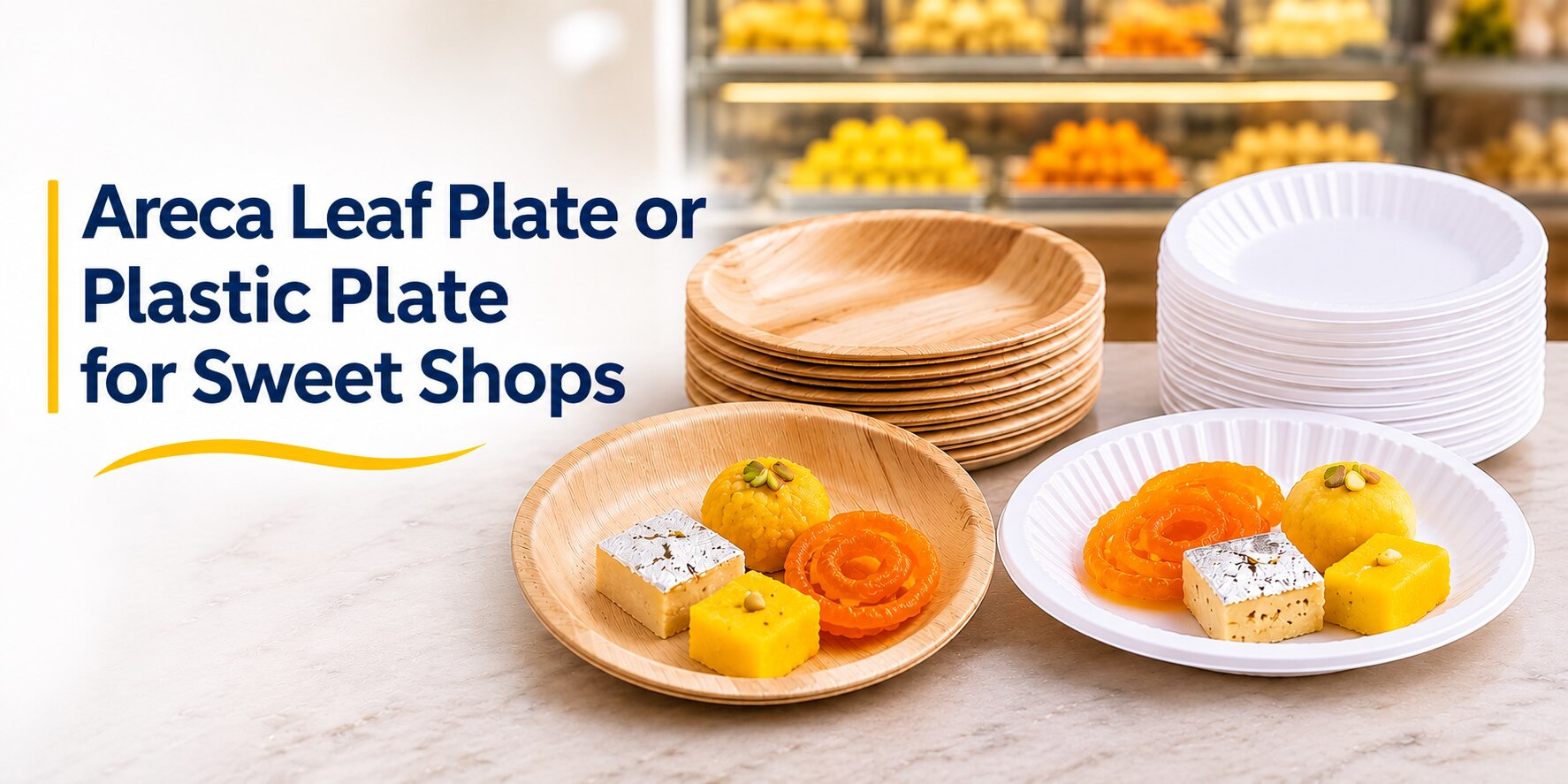
A sweet shop cannot choose between these plates on appearance or unit price alone: the food’s moisture, serving time, transport method and the legal status of single-use plastic all change the answer. Use the comparison below to match each sweet or snack to an open plate, a reusable service plate or a lidded takeaway pack, then test the exact format before ordering cartons.
Key takeaways
- Use areca plates for dry or semi-dry sweets and compliant takeaway service.
- Match plate depth and size to syrup, ghee, weight and serving time.
- Check rim strength, flatness, odour, cracks and moisture resistance before approval.
- Calculate cost per serving using breakage, storage space, labour and supplier terms.
Start with compliance, then match the plate to the food
India’s 1 July 2022 single-use-plastic restrictions cover plastic plates, cups, glasses, cutlery and trays. For a Bangalore sweet shop, an areca leaf plate is the legally and operationally sensible default for dry or semi-dry service, while disposable plastic is not a routine compliant alternative simply because it is food-grade.
FSSAI packaging rules still apply: the plate must be food grade, clean, hygienic and suitable for its intended use, without transferring unacceptable odour, taste, colour or contaminants. Ask the supplier for a food-contact or material declaration. “Natural” alone proves nothing.
Use this rule for the areca leaf plate versus plastic plate for sweet shops in bangalore:
| Use case | Sensible default | Check before approval |
|---|---|---|
| Dry sweets, samosas or snacks | Areca plate | Stiffness, clean edge and oil staining |
| Counter tasting | Areca plate | Hot-product contact and comfortable handling |
| Jalebi, gulab jamun or rasgulla | Tested areca or lidded compliant pack | Syrup leakage during the full holding period |
| Cream pastry, cake or refrigerated food | Moisture-tested areca with an inner barrier, or a separate compliant pack | Condensation, softening and contamination |
| Delivery or long takeaway holding | Lidded compliant pack | Seal, leakage and stacking strength |
Load an areca sample with the shop’s wettest product for the intended holding time. Do not accept “microwave-safe” or “oven-safe” claims without a stated temperature, duration and food load; those claims are not interchangeable.
Choose by sweet, serving time and leakage risk
Dry sweets, short counter service and low-moisture bakery items fit an areca plate best. Syrup, cream, gravy and long holding time call for a different pack.
| Food or use | Areca plate fit | Use a different pack when |
|---|---|---|
| Dry sweets such as peda, kaju katli, barfi and laddoo | Counter display, tasting and short takeaway service | The assortment includes a wet sweet or sealed delivery |
| Jalebi | Immediate serving while crisp, with limited quantity | Holding exceeds a short service period; syrup can seep through seams |
| Gulab jamun and rasgulla | Only for immediate eating with minimal liquid | Any syrup is packed with the sweet, or the order travels; use a leak-resistant food container |
| Dry snacks such as chakli, mixture, samosa and kachori | Counter servings and short takeaway orders | Oil staining, stacking or transport could soften the plate; add a tested inner liner or use a container |
| Dry cakes and plain pastries | Individual servings and display use when the edge is smooth and rigid | Refrigeration, condensation or extended takeaway holding affects strength |
| Cream cakes, cream pastries and syrup-soaked desserts | Not as the sole food-contact pack | Use a compliant inner tray or lidded container with a tested moisture barrier |
Treat mixed orders as wet as their wettest item. A plate that survives ten minutes at the counter can fail during delivery because condensation, movement and stacking increase leakage and crushing.
Before approval, load a sample with the shop’s wettest product and intended portion. Hold it for the full service or delivery period, then check the underside, seams, rim, stiffness and food contact surface.
Specify and test an areca plate before approving it
Approve an areca plate only after it holds the shop’s actual portion, not a token dry sample. The areca plate specifications for bakeries in Bangalore must state outside and usable internal diameter, depth, rim height, piece weight or thickness, dimensional tolerance, surface finish and maximum defect rate.
A nominal 12-inch plate may offer far less food area after pressing and trimming.
1. Measure ten plates. Record internal diameter, depth and rim height; reject lots with sharp edges, splinters, loose fibres, cracks or large variations. Check that the plate sits flat and nests without wobbling.
2. Load each sample with the heaviest intended serving: dry sweets, a snack combo, cake or pastry. Add jalebi, gulab jamun or rasgulla separately if those products will touch the plate. Weigh the load and hold it for the planned counter or takeaway period.
3. Inspect at 30 minutes, two hours and the longest expected holding time. Reject a plate that sags, leaks syrup, stains through with oil, softens at the base or makes the food touch the counter.
4. Test stacking with the planned number of filled plates. If the rim crushes lower plates or the stack becomes unstable, increase stiffness or reduce the stack height.
5. For cream-filled, refrigerated or syrup-soaked products, require a tested moisture barrier or a separate compliant inner pack. A dry cake trial does not approve the plate for wet food; ask for the thickness or weight range, moisture condition and replacement terms for cracked or mould-affected stock.
Where a 12-inch plate fits in the shop’s service workflow
A 12 inch areca leaf plate for sweet shops in Bangalore fits counter service, dry-sweet portions and party snacks when the food is eaten soon after plating. It is not a complete takeaway pack: syrup, condensation and movement can turn a sound plate into a leaking order.
| Service use | Good fit | Pack decision |
|---|---|---|
| Counter tasting | Dry mithai, peda, laddoo, kaju katli, samosa or a small cake slice | Open plate is sufficient for immediate eating |
| Takeaway order | Dry sweets, bakery pieces and fried snacks with little residual oil | Use a sleeve or bag; add a lid for stacking or transport |
| Party portion | Mixed dry sweets, snacks and cake pieces served within a short period | Open plate suits buffet service; cover if guests carry portions away |
| Delivery or wet assortment | Jalebi, gulab jamun, rasgulla, gravy-filled snacks, cream pastries or syrup-soaked sweets | Use a lidded, leak-resistant pack with headspace |
1. Measure the usable food area, not just the outside diameter. A high rim or sharply pressed centre can leave less room than the nominal 12 inches suggests, so test the actual customer portion.
2. Load the plate with the shop’s wettest item, including syrup, ghee or oil, then hold it for the planned counter or transport time. Reject it if the underside stains, the seam leaks, the rim softens or the plate bends when lifted.
3. Choose a lidded pack when the order will travel, be stacked, enter refrigeration, or contain separate wet and dry items. Keep the lid from touching cream or toppings; crushing makes an otherwise suitable plate unsuitable.
Compare storage, supplier terms and the true cost per serving
A cheap carton is not a cheap serving if cracked plates, rejected pieces and extra storage consume the saving. Also, plastic plates are not a normal compliant alternative: India’s 1 July 2022 single-use-plastic restrictions cover plastic plates, cups, glasses, cutlery and trays.
| Option | Storage and handling | True cost per serving |
|---|---|---|
| Areca leaf plate | Keep dry, off the floor and away from damp walls; nesting saves shelf space but crushed rims increase waste. | Invoice value divided by accepted pieces, plus breakage, rejected stock, storage space and staff handling. |
| Plastic plate | Usually uniform and lighter, but the banned single-use format creates compliance risk. | Do not compare price alone; include compliant replacement cost and disposal obligations. |
| Areca plus lidded pack | Adds a container or lid when syrup, oil or delivery time makes an open plate unsuitable. | Add the lid, outer pack and sealing labour to the plate cost. |
Ask the supplier for these terms in writing:
- Outside and internal diameter, depth, rim profile and tolerance—not just “12 inch”.
- Plate weight or thickness, nesting count, pieces per carton and carton dimensions.
- Moisture condition, maximum defect rate and the number of usable pieces expected.
- Delivery lead time and replacement terms for cracked, mould-affected or odour-bearing stock.
- A food-contact declaration confirming clean, hygienic, food-grade material suitable for your sweets.
Ankita Enterprises can be compared on those measurable terms when you seek a Bangalore supplier, rather than on “natural” or “premium” wording. Calculate the accepted-piece cost after a sample inspection and a wet-food holding test.
Related products
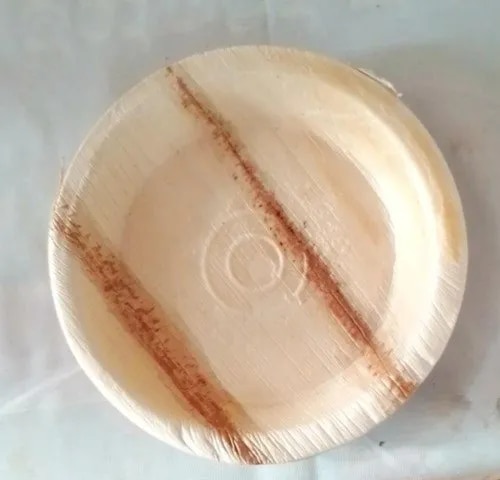 | Disposable Plates We are the Dealers of Food Containers, Sugarcane Bagasse Products, Brown Paper Bags & Pouches, Corrugated Pizza Box, Disposable Hand Gloves,... View product → |
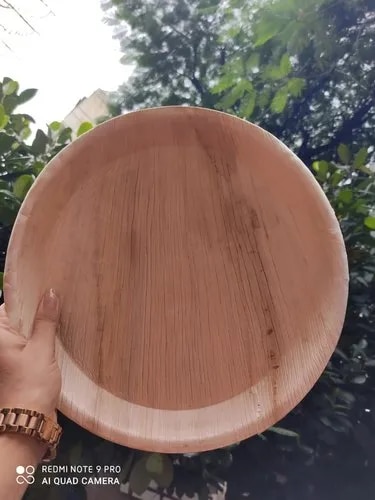 | Disposable Plates 10inches Areca Leaf Round Plate We are the Dealers of Food Containers, Sugarcane Bagasse Products, Brown Paper Bags & Pouches, Corrugated Pizza Box, Disposable Hand Gloves,... View product → |
Frequently asked questions
Are areca leaf plates better than plastic plates for sweet shops in Bangalore?
For dry or semi-dry sweet service, areca leaf plates provide a practical default under India’s single-use-plastic restrictions. Choose the plate after checking food moisture, serving time and leakage risk.
What should you check before approving an areca plate supplier?
Request a sample and check the diameter, usable depth, rim strength, flatness, odour, cracks, moisture resistance and consistency across cartons. Test the plate with the actual sweet and holding time.
When does a 12-inch areca leaf plate suit a sweet shop?
A 12-inch plate suits larger assortments, party orders and counter service where staff need room to separate sweets. Check your packing shelf, display area, bags and delivery cartons before standardising it.
How should a sweet shop compare the true cost of areca and plastic plates?
Compare purchase price per usable plate, then add breakage, rejected pieces, storage space, packing time, leakage-related waste and supplier delivery terms.
Related product
 | Disposable Plates We are the Dealers of Food Containers, Sugarcane Bagasse Products, Brown Paper Bags & Pouches, Corrugated Pizza Box, Disposable Hand Gloves,... View product → |
Keywords