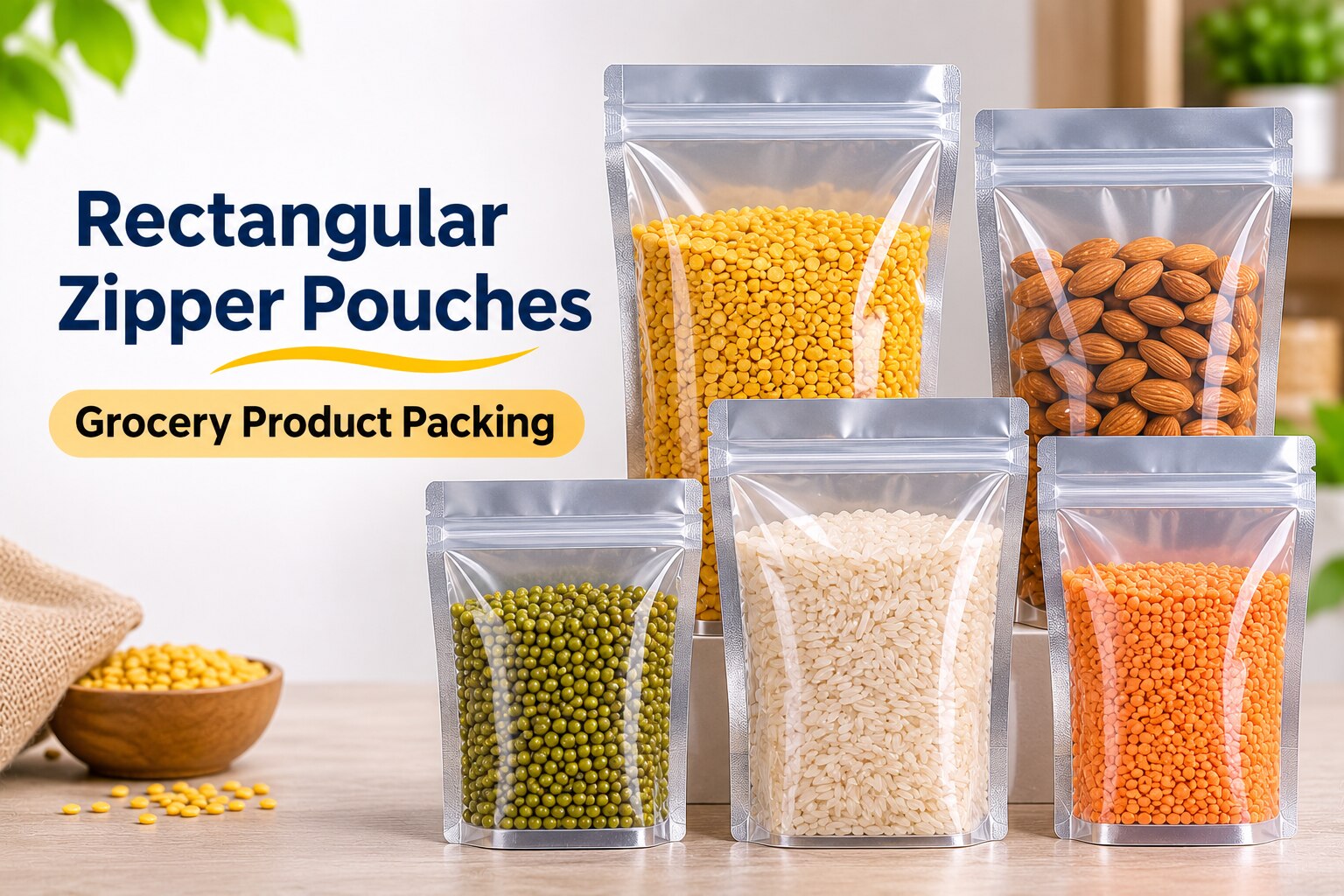
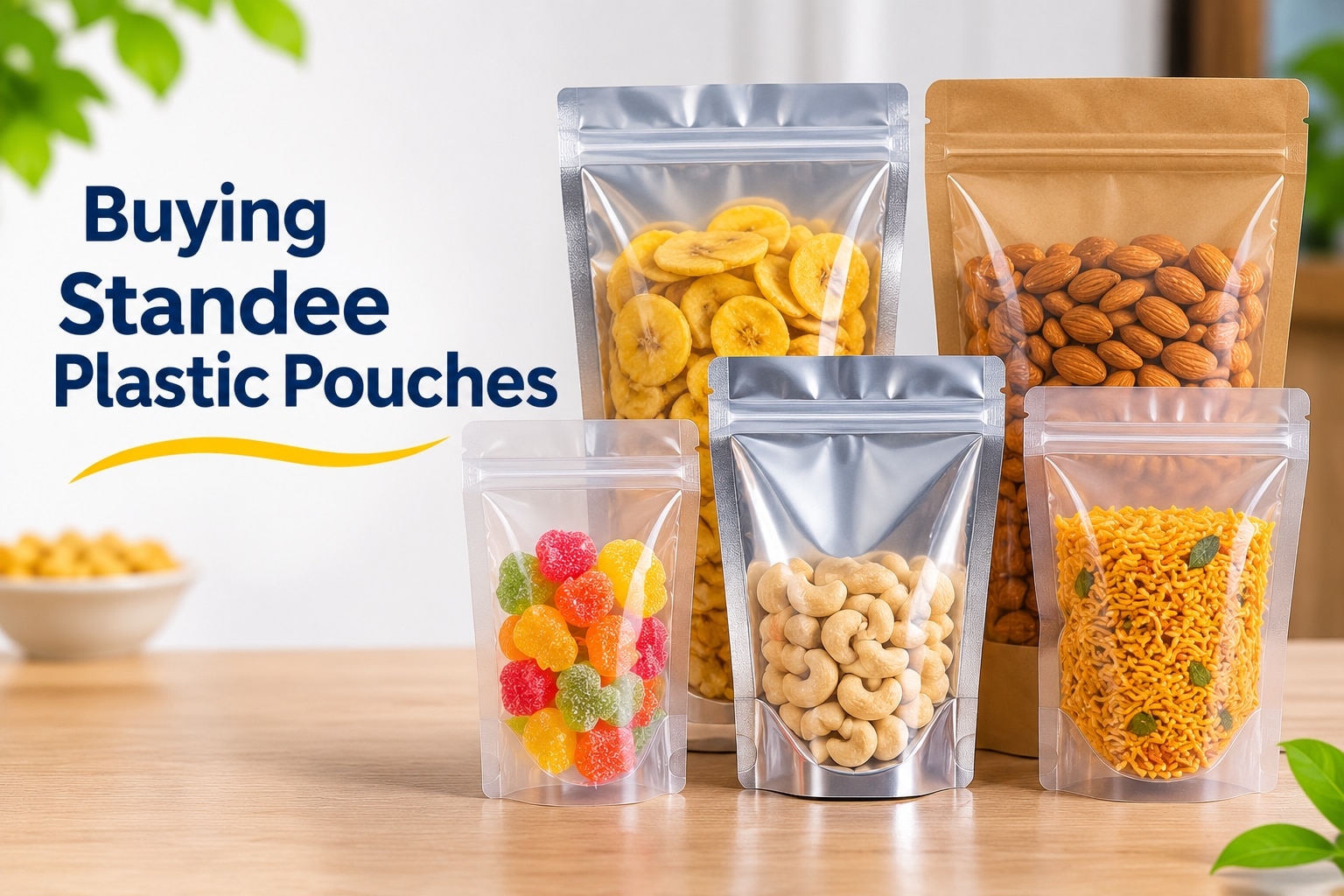
A standee pouch is not defined by its name alone: its gusset, laminate, closure and filled dimensions determine whether it will stand, protect food and seal reliably. By the end, you will have a practical specification and quotation checklist for comparing suppliers, approving samples and placing an order with fewer surprises.
Key takeaways
- Record filled and lay-flat dimensions separately.
- Match laminate barriers to moisture, oxygen and grease exposure.
- List every closure, seal and pouch inclusion in writing.
- Approve a filled sample before confirming the Bangalore quotation.
Confirm the finished dimensions, gusset and standing performance
1. Ask the supplier to record finished filled dimensions separately from lay-flat dimensions. Your standee plastic pouch order details in Bangalore should state pouch width, usable body height, bottom-gusset depth, top-seal width, fill weight in grams or volume in millilitres, and permitted size tolerance.
A nominal size such as 150 × 220 millimetres does not show usable capacity because the gusset and top seal reduce internal height.
2. Confirm the base construction in the standee pouch specifications: K-seal, Doyen-style or another gusset design. Ask whether the empty pouch stands upright or becomes stable only after filling. A pouch that looks upright in a catalogue can tip when its contents settle.
3. Request a filled-product standing trial using your actual cookies, rusks, brownies, dry cake slices or namkeen. Product distribution, bulk density and fill weight affect balance, so check the pouch on a shelf, after transport movement and after the product settles. Reject it if it tips, leans or collapses.
4. Specify the corner shape, seal width, rounded corners, handle and transparent window. Use the trial to confirm headspace: too little crushes bakery items, while too much allows movement that increases breakage and aroma loss.
Record the fill temperature and storage conditions used in the trial, because heat and humidity can alter seal performance and pouch shape.
Match the laminate and barrier to the bakery product
Ask for the complete standee pouch specifications, not the description “food-grade plastic.” The quotation must identify every layer and its thickness, such as PET/PE, PET/met-PET/PE or PET/foil/PE. This structure determines stiffness, heat-sealability, oxygen ingress, moisture transfer, aroma retention, light protection and recyclability.
For a standee pouch for bakery products, name the failure you need to prevent:
- Cookies and rusks: prevent moisture pickup and loss of crispness. Check moisture-barrier data and whether the seal remains intact during delivery.
- Fried bakery items: check resistance to grease migration, oxygen ingress and oxidation. A metallised or foil layer can improve oxygen, aroma and light barriers.
- Brownies and dry cake slices: seek the right balance of flexibility, moisture management and aroma retention rather than automatically choosing the heaviest laminate.
- Cream-filled, moist or refrigerated products: require product-specific suitability. A pouch designed for dry foods does not prove compatibility with moisture, refrigeration or condensation.
Ask the supplier whether the structure resists grease migration, oxygen ingress, aroma loss and light exposure throughout storage and delivery. Confirm the permitted filling temperature, warehouse temperature, humidity range, refrigeration compatibility and storage limit. These conditions affect seal performance, odour, curl and barrier behaviour.
Require stated oxygen and moisture barrier data or a product-specific shelf-life assessment. Do not accept an unsupported shelf-life promise; a simpler structure may suit a short-life product, while a metallised or foil laminate adds protection but can reduce recyclability.
Specify the closure, seal and every pouch inclusion
Choose the opening before approving the pouch: zipper, slider, tear notch, laser score, spout, valve, or only a heat-sealed top. A zipper is not a hermetic primary seal. For bakery products, require a top heat seal above the zipper and confirm that consumers will tear through that seal.
1. Ask for the heat-sealing window, seal-strength specification, recommended temperature, dwell time and jaw pressure. Test flour, crumbs, oil or filling residue on the seal, because contamination tolerance and machine-jaw design determine whether leakage occurs.
2. Confirm the valve type when the product releases gas: one-way allows gas out, while two-way allows gas in and out. Ask whether a transparent window reduces light protection, and whether rounded corners, a handle or sealing service are included.
3. Put every standee pouch inclusions item into the quotation: zipper or slider, tear notch, laser score, spout, valve, window, printed artwork, label area, printing plates or cylinders, artwork proof, production sample, testing, carton packing, freight to Bangalore, GST, and replacement of defective or leaking pouches.
4. Request a sample filled and sealed on your equipment. Check zipper function, tear opening, seal appearance, print registration and odour, then test leakage after drop and compression handling. Colour approval alone cannot reveal closure or sealing failures.
Require the supplier to record the approved closure, seal settings and inclusions. A low unit price is not comparable if testing, packing or replacement coverage is missing.
Obtain food-contact, labelling and plastic-compliance documents
1. Request a food-contact compliance declaration and recent migration-test report for the actual finished laminate, including film layers, ink, adhesive and sealant. A certificate for one film layer does not cover the completed pouch.
Ask the supplier to identify the food-contact side and confirm that inks, coatings and adhesives are not printed on it unless designed and tested for direct contact.
2. Check the converter’s reverse-printing process, adhesive curing records and migration results. Reverse printing reduces direct ink contact, but adhesive migration and incomplete curing can still contaminate food. Record these requirements in the standee pouch specifications before approving production.
3. Freeze the artwork yourself before release. For packaged food, verify the food name, ingredients, allergen information, nutrition declaration, vegetarian or non-vegetarian symbol, net quantity, batch or lot number, date marking, manufacturer or packer details and consumer-care information under applicable FSSAI and Legal Metrology requirements.
Do not let the converter print statutory details from an unapproved draft.
4. Obtain the material composition and ask how the flexible structure is classified under India’s Plastic Waste Management Rules. Confirm who will handle Extended Producer Responsibility reporting and request the supporting EPR documentation. Treat “recyclable” as unverified until the supplier identifies whether the pouch is mono-material or multilayer and provides its classification.
Include these documents in the standee pouch inclusions checklist.
Compare the Bangalore quotation, lead time and approval sample
A Bangalore sales address does not prove local manufacturing or a short production lead time. Separate distributor stock from made-to-order conversion before comparing a plastic standee pouch supplier in Bangalore.
| Option | What it means | Confirm before ordering |
|---|---|---|
| Distributor stock | Finished pouches held for dispatch | Manufacturing location, storage conditions, available sizes and artwork, minimum billable quantity, delivery terms and partial-delivery rules |
| Made-to-order conversion | Pouches produced or printed against your specification | Minimum order quantity by size and artwork, repeat-order lead time, manufacturing location, GST treatment, freight to Bangalore and payment milestones |
Put these standee plastic pouch order details in Bangalore in writing, including whether the quoted price covers the zipper or slider, tear notch, artwork proof, printing plates or cylinders, pilot samples, testing, carton packing, GST, freight and replacement of defective or leaking pouches.
Require an approval sample or pilot lot before committing to a large order. Measure filled dimensions, check standing stability, test the zipper and tear-notch opening, inspect print registration and odour, and run the pouch through your filling and sealing equipment. Test leakage after drop, compression and ordinary handling.
Record the approved laminate structure, micron thickness, dimensions, closure, artwork version, seal settings and acceptance tolerances. A repeat order then has a measurable specification instead of memory. For options from Ankita Enterprises, apply the same written checklist and sample tests used for every supplier, so fit, barrier, compliance, inclusions and delivery—not the lowest unit price—decide.
Related product
 | Packaging Pouch We are the Dealers of Food Containers, Sugarcane Bagasse Products, Brown Paper Bags & Pouches, Corrugated Pizza Box, Disposable Hand Gloves,... View product → |
Frequently asked questions
Which dimensions belong in standee plastic pouch order details in Bangalore?
Record finished width, usable body height, bottom-gusset depth, top-seal width, fill weight or volume, and permitted tolerances. Record filled dimensions separately from lay-flat dimensions.
How do you choose standee pouch specifications for bakery products?
Match the laminate and barrier to the product’s moisture, oxygen, grease, aroma and light sensitivity. A dry biscuit and a cream-filled pastry do not need the same structure.
What standee pouch inclusions must you specify?
State whether the order includes a zipper, tear notch, spout, handle, rounded corners, hang hole, window, printing, top seal and any required internal or external finish.
Which documents should you request from a plastic standee pouch supplier in Bangalore?
Request food-contact declarations or test reports, material and laminate details, batch traceability, labelling information, and documents showing compliance with plastic rules that apply to the product and packaging.
How should you compare Bangalore pouch quotations and samples?
Compare the complete specification, included features, material structure, quantity, lead time, wastage terms and delivery conditions. Fill and seal the approval sample with the actual bakery product before placing the order.
Keywords